ACHIEVING CHANGE IN AN UNCHANGEABLE ENVIRONMENT

I recently began a new job with a large organization. The organization is somewhat unique to me because it consists of two legacy organizations each made up of multiple companies. Each organization operated independently until recently when ownership decided to merge the two legacy organizations into a single corporation with shared visions and goals.

“Change is achievable in any environment, as long as all layers are iniated in the change process.” – Denis Baker

I was hired to help create a transformational change where safety and health are Fotosearch_k27534040integrated into the entire operational culture. I believe this is the only practical method for achieving safety and health goals and ultimately an incident-free culture. Safety and health should never be “first” or a “priority,” but rather a core value integrated into the culture of the organization. You see, priorities change, values do not and first is not always. I often use a pie analogy to visualize this. The pie is divided into equal pieces, with safety and health having an equal slice of the total pie. No more, no less, but equal.

Whether your profession is safety or finance, the successful process of change is the same. Here are 10 principles to follow when initiating change. Execute these, and your efforts will be made fruitful.

1. Have compassion and understanding. Regardless of circumstances, change is scary, and you represent a terrifying unknown. Every location I visit, after we complete the professional introductions and small talk, I am met immediate resistance. And most will try and distance themselves. When I begin touring, asking questions and making suggestions, encounter looks of concern or frustration and often hear, “but that is not the way we do it,” or we’ve always done it this way.” To help soften my perceived impact, I often encourage their suggestions or solutions. This creates a great team-centered environment that allows them to consider any of my initiatives. Probably, the most important thing I’ve come to realize, is their reactions aren’t personal; they are just responding to an uninvited change.

2. Reach out and connect with those affected by the change. Success in anything cannot be achieved without effective relationships. Before a relationship can begin, one must first connect with the person or group. Do this by identifying common ground. Look for small wins that build respect and credibility.  In the beginning, change can be frustrating for both sides. It will be tempting to simply brush off questions or concerns, because you may feel it is easier to just do it. And it is. However, I BEG YOU to RESIST that urge! No doubt we want quick results, but you’re better off starting slow and finding common ground. Find opportunities for one-on-one interactions. For change to be successful, connecting with those affected requires consistent, realistic, heartfelt conversation.

3. Influence the influencers. Influence those who have influence, without neglecting the others. Pay attention to group dynamics and identify the influencers. Identify who they are, and get to know them immediately. Learn what they value and be transparent in addressing their needs, concerns or wants. Just remember, you can’t do or control what you don’t control.

4. Expect resistance and don’t ignore it. Resistance is always present for any change, especially culture change. Don’t think it will go away on its own, it won’t. In fact, if left unattended, it will multiply and infiltrate the entire organization. Once this occurs, your job just got tougher. Meet with the discontent. Put your pride aside and listen. Address each issue as it comes up, but don’t make any promises or commitments you can achieve. If that happens, you just lost all the trust and respect you’ve been working to achieve. Gain buy-in by understanding the reasons getting buy-in for your vision and goals for change. Realize that most of the resistors are the influencers.

5. Communicate your values. In the safety profession, it’tempting to withdraw when you encounter conflict, but you have to do the opposite. You’ve got to overcommunicate. Look for ways to demonstrate your values as you explain your vision. You want to reassure people that your principles are positive and show where your values align with theirs. The key is to be steady, positive and consistent.

6. Learn from other leaders. How do others achieve change? Read, ask and network, looking for ways and ideas that might work in your situation. I often tell people to go with their gut. Meaning, if your intuition is saying yes or no, then follow that “gut feeling” and move forward. As we say in the safety profession, “steal shamelessly.” Great leaders learn to steal the best ideas. Remember, their approach or tactics are vetted and proven.

7. Go forward boldly. Don’t be afraid to make mistakes. (Just be sure to fix them faster than you make them!) Stop and assess yourself, your process and your progress often, and course-correct as needed. Mistakes are inevitable. Keep it moving.

8. Prioritize and act. Identify the one or two areas where you will receive the greatest benefit and make that your priority effort. However, always evaluate your progress, the level of reception, the level of effectiveness and be ready to make changes as needed.Remember you are the change agent, you must be willing to change.

9. Create wins for the organization. Never underestimate the power of early victories. They give people confidence to keep pushing forward, even though turning the ship is hard. Achieving an early win builds momentum. People trust leaders with a proven track record. They will accept changes from people who have led them to victory before. Remember, it is easier to steer a moving train than stop it.

10. Identify and equip other leaders. If you want to sustain change and start building momentum, you must start developing and equipping the leaders. This is something many organizations fail at. We take the best worker and make them the leader. Great principle, but horrible execution. We tend to neglect the coaching and training needed to make that person successful. Look for those who rise to the top and pour into them your coaching and mentoring efforts to see them become the best leaders possible.

When I am looking for a job, I tend to identify companies where change is needed. In Fotosearch_k21722018fact, I have been a crucial part of at least six organizations where a cultural change was required. I approach each opportunity by implementing these 10 principles. Execute these 10 principles and watch change take place.

What Message Are You Sending? PART 2 of 3 – 11 Rules and Etiquette for Crafting and Sending Effective Emails

raspberry-send-email-gmail-ssmtp

The way you craft or respond to an email determines the effectiveness of your words. That drives the intended outcome and creates the influence you desire.

When replying to emails, consider these ten (11) suggestions:

  1. Organize your words and paragraphs to make it easy for readers to follow and understand.
  2. Reflect on the email content before replying. Your leadership effectiveness is reflected in your response.
  3. Don’t automatically hit “Reply All.”  This should only be used when needed and with extreme caution.  You should only use “Reply All” when everyone on the “TO” list requires your response.  Most of the time, it is sufficient to only respond to the person who sent the email.
  4. Be Careful with the “Bcc.” The “Bcc:” option allows you to “blind carbon copy” someone on an email without any of the other recipients knowing. It can be useful in some cases when you wish to keep email addresses private.
  5. Avoid Cursing. Cursing in an email is just wrong. Don’t do it. Swearing in an email comes off as being ignorant or showing a lacking intelligence.
  6. Use proper grammar.  Don’t write like you speak. Remember, emails are forwarded all the time.
  7. Respond Regardless. Everyone would deserve a response, even if the email were mistakenly sent to you.  A simple, “I got your email,” or “I think this was addressed to me by mistake” will let the sender know you got the message.
  8. Be leery of tone. Each person interprets email tone differently.  A well-written email can easily be interpreted as a negative with the use of various words.  Many people use all caps. Doing this implies YOUR YELLING AT SOMEONE.
  9. Don’t Be Cute There is no room for cuteness or EMOJI’s, inappropriate pictures, etc.
  10. Include a professional signature. Include; your full name, title, work address and phone number.  When using a quote or image, be careful that it does not offend.
  11. Read it, then reread it. Read and re-read your email. Make sure your grammar, spelling, and choice of words portray the intended tone and message.

HOW TO REMAIN ENCOURAGED DURING DIFFICULT TIMES

You remember the saying, “Let the good times roll.” Well, sometimes the good times turn bad. We enjoy the benefit of things going well and t’s easy to encourage others when they’re down. But sooner or later, we will enter into difficult times. It’s inevitable. As I said in my last post, “How to Remain Motivated and Influential During Difficult Times,” I stated that, “no one will escape difficulty in life.” The reality is, there will be times of discouragement. But discouragement doesn’t mean we have to fall apart or quit.

I look to the scriptures for my daily encouragement. When difficult times hit, I find it even more important to study and mediatiate. Here are five bible verses to encourage you during difficult times.

Psalms46_3_1to7

nahum1_7

Psalms62_6

2Timothy1_7

Isaiah41_10

How to Stay Motivated and Influential in Difficult Times

“People often say that motivation doesn’t last. Well, neither does bathing – that’s why we recommend it daily.” Zig Ziglar

motivation concept with business elements and related keywords

It’s Friday, you are finishing up a few last things and then heading out for the weekend. As you are sitting in your office reading a report, you hear a light tap on the door. Looking up, you see your boss closing the door. S/he starts out by saying, you have really done an excellent job, but…… you probably know where this ends. Most of us have been there. You are about to encounter the harsh truth, you are out of a job. Maybe you just received news that you or a loved one has been diagnosed with cancer. Or maybe you find yourself falling on difficult financial times. Whatever it may be, there will be difficult times in all of our lives. Difficult times also bring on frustration, anxiety, and fear of the unknown.

As you stare down on this big ugly beast, realize that your reaction will determine your success or failure. What will your reaction be, discouragement or comfort? Your answer depends on you. I think we all feel disbelief and despair in the beginning. But it doesn’t have to consume us. In fact, I believe we must take advantage of these situations and find ways to stay motivated and encouraged in difficult times.

Here are 10 ways I stay motivated during difficult times:

  1. Realize life flows up and down – Life is a cycle. There will always be good and bad times. It’s how we react and handle those times that determine our future.
  2. Remember, things don’t change overnight – Things take time to work out. Be patient and work diligently for your desired outcome.
  3. Focus on the positive – Although the past is with us, it doesn’t have to haunt us. Focus on what matters today and tomorrow. Remember, yesterday ended last night, focus on today in preparation for tomorrow.
  4. Continue self-growth – When difficult or trying times hit, it is a perfect time to take personal inventory and determine where you need to grow.  Spend time becoming a better you. Physically, mentally and spiritually. You can GROW or GROAN. However, I don’t think the latter will get you much.
  5. Consider all options – Take time to consider your options. Maybe it is time for a career change, or to downsize in your home, vehicles, etc. Whatever it may be, remain open and ready to take initiative.
  6. Serve others – As difficult times come upon us, look for ways to help others succeed. In fact, this is an excellent time to move the situation away from you. Serving others creates a heart of gratitude and gives us the opportunity to meet the needs of others.
  7. Consider the big picture – Remember that everything happens for a reason. You may be the reason you have fallen on difficult times. Whatever the reason, maintain a big picture point of view. Consider your current situation and look for opportunities to achieve your future desires and goals. Never a better time than the present to begin a new road to the future.
  8. Embrace change head-on – Change. I LOVE IT! Many hate it, fight it and despise it. Become a person who embraces change. Consider the many opportunities change presents and capitalize on them. Remember, the only thing constant in life is….change.
  9. Never give up – Whatever you do, don’t give up and don’t settle. Too many give in too quickly. Continue to push through the muck and mud, and you will be victorious!
  10. Pray and stay in the Word – During difficult times, it’s important to understand where your strength comes from. I  believe one must stay connected to God through prayer and reading His Word, the Bible.

These 10 ways help me maintain my motivation during the difficult times. I believe one or all can help you do the same. Remember that difficult times affect us all. No one escapes the difficult times in life. However, the way we handle and react in those times determines our success or failure.

When you remain motivated, others see how well you adapt and handle the situation and will allow you to influence them. Tim Tebow said, “I’ll always use the negative as more motivation to work even harder and become even stronger.” Use the difficult times to become a better and stronger person.

motion


Self-Leadership, My Most Difficult Challenge

businesswoman hands holding sign find your way text messageWhy is leading myself more difficult than leading others? I ask myself this question EVERY SINGLE day!

Why do I say or do things I know are wrong (there is a biblical reference here)? It happens at home, work, with my wife, with my co-workers and those I love and lead.

The answer is simple. There are areas I don’t see until they sprout up. In fact, I believe there are times I don’t see myself from a realistic point. I see myself from my intentions, AND others see me through my actions and words.  I should probably also admit that I see my intentions from the training and talks I give.

self-lead 2.jpg

While I speak of myself, I am sure I’m not alone.  But how does one address this issue? Answer, look for the blind spots and deal with them! However, how do we identify the blind spots?  I look personally to three source for my self-leadership:

  1. Scripture
  2. My wife
  3. Co-workers and staff

These sources provide direct and/or indirect insights to the areas I need to change or improve.  With this information, I can apply these five principles.

  1. Control Emotions –  Like anyone else, leaders have  emotions.  In fact, I believe a leader’s emotions can be more powerful due to the passion and desire for success they possess.  However, a good leader knows how to control their emotions and display or delay them based on the situation.
  2. Meditate – Leaders are achievers.  And that means they hit the ground running, which leaves little time to stop and think.  Spend 30-45 minutes every morning mediating on the things that matter and planning your day.
  3. Focus Your Effort Where it Matters– A good leader wants to achieve more.  They are never satisfied with their achievements. For me, I tend to want to fix everything and solve everyone’s problems. However, to be effective we must learn to focus our efforts on what really matters.  I heard John Maxwell say, ” You can’t be 100% all the time.” I find that statement very true.  We must identify the times and events where we need to be 100% .  Everything else gets a good effort,  just not our best.
  4. Serve Others – Zig Ziggler said, You can have everything in life, if you will just help enough other people get what they want.”  I am finding this to be very true.  Not from a selfish perspective, but simply from putting others first in every action or decision. Throughout my career, I have seen and reaped the benefits of putting others first by gaining their respect, commitment and dedication.  I simply look at it as, “you reap what you sow.”
  5. Get a Coach and/or Mentor – We all need to keep our minds sharp and our thoughts and ideas flowing freely.  Our minds can freeze or we experience those “blind spots” that throw us for a loop.  As a Coach and Mentor, I see the benefit from asking stimulating questions and the ability to seek wisdom and advice from others. I personally have at least five mentors that I can rely on for helping to address questions or walk me through situations.  I sleep better knowing I have access to these individuals.  I also can call several coaching colleagues for encouragement and guidance when needed.

Take the time to evaluate the effectiveness of your self-leadership to these five principles. Then establish a process where you consistently work to apply these principles and improve where needed.

A leader’s greatest challenge and most difficult task, is self-leadership. If you lead yourself correctly, you will influence others and they will follow.  Failure to manage your self-leadership will create a loss of respect and the inability to influence, causing people to leave and follow others.

self-lead 1.jpeg

READY, FIRE, AIM, The Initiative Concept for Leadership Abundance and Success

Ready Fire AimIf you know what to do, then just do it!  I could probably stop right there and have the shortest blog I’ve ever written.  But that would be boring.

As a leader, one of the most frustrating things is to have someone on my team not take the initiative to make things happen.  Instead they sit back and wait for direction, or constantly need my approval that their path or ideas are right.

I want people that are willing to take risks, learn from their mistakes and accomplish what they never thought could be done.  I encourage and expect my staff to embrace the idea of READY, FIRE, AIM!  A concept I learned years ago and I have refined recently.

Let me break the term down:

  • READY – Identify what needs to be accomplished and evaluate what it takes to fully and completely accomplish the task or idea.
  • FIRE – Go do it!  Don’t wait.  Be the swoosh in NIKE and “Just Do It.”  For my inner circle, there are very few times where this concept wouldn’t apply.
  • AIM – Once you “Do It”, then tweek as needed.  If you did your due diligence in the READY phase, there should be very little need to correct things.

These three simple words can create extreme success in your leadership and success in the workplace.

Here are three examples of people who embraced the concept of READY, FIRE, AIM:

  1. Elon Musk – When you make millions off of an internet company like PayPal, the world generally expects you to, well, create and make more millions off of another internet company. But Elon Musk’s dreams lay elsewhere: Rather than follow a more conventional career path, Musk took the money he had made at PayPal and invested it in two of his own highly innovative startups, SpaceX and Tesla. Though his attempt at operating these two ventures at once nearly sent both companies into bankruptcy, it seems to have ultimately paid off—today, both SpaceX and Tesla thrive.
  2. Sylvester Stallone – With a baby on the way and too little money to pay the rent on his Hollywood apartment, Sylvester Stallone sat down and wrote the screenplay for Rocky in less than four days. Producers loved it and offered him big bucks to bring the story to life—but Stallone, as down-and-out as he was, refused to take any offer if he wasn’t allowed to play the lead role in the film.  Rocky ultimately ended up pulling in millions of dollars and skyrocketing Sly into fame.
  3. Travis Kalanick: Uber – Travis is a great example of Ready, Fire, Aim.  If he become discouraged with failure, Uber wouldn’t exist.  Founded the company Scour Inc., a multimedia search engine, and Scour Exchange, a peer-to-peer file sharing service. Two years later, the company would come under fire from several big name music and film agencies for copyright infringement, forcing Scour to eventually succumb to bankruptcy.  In 2007, Kalanick and Garrett Camp founded Uber. After facing some early competition and funding concerns, the ridesharing app is now the most widely used app of its kind. Kalanick created three companies; one failed, but that did not stop him from taking the risk.

Taking initiative is an important part of most any job and is critical to increasing your influence and ultimately your leadership.  However, the reality is that not many of us will not end up as successful as Elton, Sylvester or Travis.  But I can say people who take initiative, are people I want in my inner circle.  And I bet that is the way many leaders feel.

I agree with Conrad Hilton said, “Success seems to be connected with action.  Successful people keep moving,.  They make mistakes, but they don’t quit.” 

Don’t keep talking about it, just “DO IT.”

swoosh

INSIGHTFUL THOUGHTS ON CHANGE

Change Colorful Random Shapes

Change happens.  In fact, the only constant in life , is change.  I once told someone,

“The only things I can count on are; birth, death and change!”

If the world is going to continue, then change must occur, plain and simple.  As simple as it sounds, change is not easy.  There is always some stress involved, regardless if it’s our own choosing or not.

I recently changed jobs, which to many, was somewhat of a surprise.  I left a job that I was seemingly happy at.  I made a good living and had taken a company from virtually having no safety program to being a program desired by many competitors and even customers. It was a job I was successful at and generated a lot of personal and professional gratification.

The change meant leaving an area that I loved, a house I loved and more importantly, it meant leaving my daughter, son-in-law and my 5 month old granddaughter (my first grand baby).  So why the change?  I will provide a very simple answer at the end.

For me, job changes have been a way of life.  It typically occurs every 2-3 years.  My most recent change occurred after almost five years.  I’ve always looked at change as a positive thing.  I never want to become comfortable in a position or with a job.  I believe comfort creates complacency.  I was always working hard, looking for opportunities to improve. While the most recent change has open up the opportunity for many new challenges, it has opened my eyes to the stress it causes, not only in myself, but to those closest to me.

Change is now, handwriting with chalk on blackboard

I have come to realize all change leads to stress, even when it is of our own choosing, or is something we want.  You get a new job, buy a new house, get married, or simply buy a new car!  Well congratulations hot dog!  Now you have to wait 30 days for insurance, pay your mortgage, share your bathroom, and worry about when the first scratch will happen.

Sometimes we experience change unexpectedly, without warning.  You reach a point in life where you think you have it all under control, you hold all the cards, and everything is working just the way you want it.  Then the economy stutters, revenues decline, and you hear rumors of downsizing.   How are these changes going to affect you?  Will there be money to pay the mortgage, buy that first anniversary gift or even put gas in that shiny new vehicle?

Everything changes at some point. Whatever the change, we must adapt.  By adapting, you can learn to embrace change and conquer it for success.  However,  one must have the right mindset for accepting change.

Here are 13 quotes that will help put change in perspective.  Read these quotes and latch on to the ones that motivate and speak to your heart and mind.  Not all  of them will.  But I do think they can be beneficial when change, unexpected or planned, comes your way.

  1.  “I cannot say whether things will get better if we change; what I can say is they must change if they are to get better.” —Georg C. Lichtenberg

  2. “The price of doing the same old thing is far higher than the price of change.” – Bill Clinton

  3. “Change is the law of life. And those who look only to the past or present are certain to miss the future.” – John F. Kennedy

  4. “You never change things by fighting the existing reality. To change something, build a new model that makes the existing model obsolete.” – Buckminster Fuller

  5. “Your life does not get better by chance, it gets better by change.” —Jim Rohn

  6. “If you always do what you’ve always done, you’ll always get what you’ve always got.” —Henry Ford

  7. “When in doubt, choose change.” —Lily Leung

  8. “Change is inevitable. Change is constant.” —Benjamin Disraeli

  9. “Become a student of change. It is the only thing that will remain constant.” —Anthony D’Angelo

  10. “When we are no longer able to change a situation, we are challenged to change ourselves.” —Victor Frankl

  11. “You must welcome change as the rule but not as your ruler.” —Denis Waitley

  12. “Change before you have to.” —Jack Welch

  13. “Those who expect moments of change to be comfortable and free of conflict have not learned their history.” —Joan Wallach Scot

So why the change in jobs?  Because I am MOTIVATED by change and BORED by  redundancy!

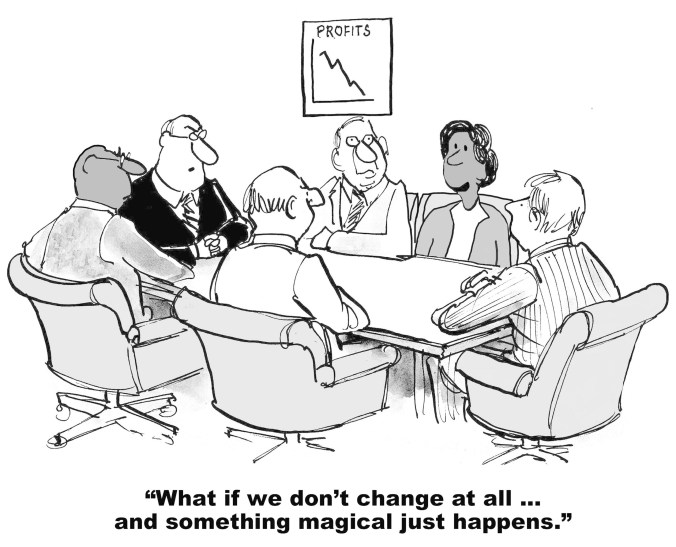
Cartoon of business people who want to avoid change.

REALLY, YOU LEAD PEOPLE?

Fotosearch_k15793683

I read an article the other day that touched on leadership behavior.  It sparked an abundance of memories, thoughts and questions that have rolled around in my head for many years.  Quite frankly it made me look deep inside of my soul and check my heart to ensure my actions and motives line up with my moral convictions.

Look, leaders are people.  In fact, many are good people.  There is a very small percentage of leaders that act and behave poorly.  I feel I’ve probably worked for more than most.  My career has been full of poor leaders.  Heck, there are a lot of my past and present employees that might say the same about me.

The whole reason I began my leadership journey was to do everything I could NOT to make the same mistakes or do the same things I have witnessed or gone through.

Through my experience, I have identified 9 things that define poor leaders.  Here they are;

  1. IT’S ALL ABOUT YOUNo it isn’t!  In fact, we probably don’t About.me_iconcare what you did or where you went.  It is about those you lead.  When every conversation and situation is about you, it limits the interaction and contribution of others.  I’ve had many leaders more concerned about how situations affect them, than the one(s) involved or affected.
  2. HEY BUDDY -Considering those you lead as friends.  Not good. Leadership is about relationships, not friendships.  When friends and buddies don’t perform we tend to “sweep” it under the rug or make excuses, rather than hold them accountable.  This creates descension and frustration with other employees.  Build relationships, not friendships.  I’ve seen many leaders lose credibility over the hiring or advancement of friends or relatives many times.  I am not saying you can’t hire employees from the past or those who supported and assisted you at other jobs.  I was the best man at my Director of EHS’ wedding 29 years ago.  However, I bet he will tell you that he is held to the same accountability level as anyone else.  In fact, I expect more out of him, than most.
  3. HORRIBLE LISTENER blah, blah, blah…….  This leader doesn’t care what you have to say.  They are only concerned with what’s coming out of his mouth.  Their EGO gets in the way.  Hey man, you were given 2 ears and 1 mouth for a reason.  You need to listen twice as much as you talk.  Give people a chance to say something.  Who knows, what they have to say might solve the problem.
  4. WHAT ARE YOU THINKING? -Poor communicators can reduce and harm aculture and frustrate employees quickly. Many employees complain about the lack of communication from leadership.  What are my expectations, Fotosearch_k10378786How is the company performing?, Will there be raises or bonuses this year?  As I coach leaders, I encourage them to have weekly or monthly communication meetings.  This is a time where all they do is communicate key information and allow employees an opportunity to ask questions.
  5. DON’T TEXT ME -Technology is great, but technology has created a diminishing environment of face to face communication.  How many times have you received a text or email and interrupted it as negative?  Texting and emails are very difficult to communicate a tone.  A face to face visit is the best way to properly communicate.  I can see your facial expressions and body language and I can react or change my tone or words to ensure effective communication.  If you can’t meet face to face, call them, and don’t leave a voice mail to cover your items.
  6. REALLY?Hear’s a thought……Get both sides of the story before you make a decision.  One of the most frustrating things for employees is when a leader makes decisions based on a one sided conversation.  One of the traits of a leader is to be open and accessible.
    However, that doesn’t mean you base your decisions on the conversations of one individual.  I found many times, my accessibility and openness has allowed individuals to voice their displeasure with a supervisor, rule or practice only to find out in my follow-up conversation the individual was disciplined or held accountable for failure to comply with or follow directions, etc.
  7. THAT WILL NEVER WORKBeing cynical is not a trait of a leader.  In fact, it is totally opposite.  I think cynical leaders feel threatened. They must discount or even put down a person’s ideas because they feel as if they are not a leader if they don’t have Fotosearch_k5253244the answer.  Cynical leaders say; “No, that’s not going to work” or, “I don’t know why we are doing this; this is stupid.”  Look, if something is stupid, then the leader needs to fix it.  If something is not worth doing or is going to create major problems, it’s your responsibility to facilitate other ideas.  Regardless, you must thank and encourage those who offer ideas and opinions, not BELITTLE them!

  8. THAT’S DISGUSTING! Just because you can say it, doesn’t make it right.  Foul language is wrong and unprofessional.   For some reason, leaders feel they have the right to use foul language and tell questionable stories in front of their staff or employees.  I recently had a leader use very disgusting language in reference to a football game. It stunned the group.  No one knew how to react.  I have had several occasions where leaders would use foul language in an email or text.  Regardless of the communication, it is WRONG!  Some have told me, “you have to talk in the language of the industry”. What?  Come on man!!  If that is the case, then we need to clean up the industry!  It doesn’t matter if you are playing, it is your normal language or if you are angry, foul language is wrong, no matter what!  Whether it’s anger, disgust or this is how you talk to your friends, you can’t bring it to the office.
    I can tell if a person has leadership qualities by the way they talk to others.
  9. YOU CROSSED THE LINE!Leaders who compromise their integrity for business or profits are FOOLS!   A lack of integrity from leaders doesn’t just annoy employees, it appalls them. In fact, when a leader shows a lack of integrity, employees become de-motivated.  When a boss breaks or fudges the rules, cheats, lies or indulges in behaviors that reveal a lack of moral principles, he loses respect. images7-220x147 respect, you can’t influence.  If you can’t influence, you can’t lead.  In addition, when a leader lacks integrity, he gives employees permission to do the same.  I’ve seen leaders compromise their integrity and moral values to be validated by others.  I have personally seen this take place and the destruction it causes.  A true leader will never comprise their moral integrity for validations.

Being a leader is about doing the right thing and leading by example. You simply cannot have one standard for yourself and one for everyone else. Treat people the way you would want to be treated.

If some of these sound familiar, then do something to correct them immediately.  The longer you continue the easier it is to continue.

Don’t Be a Liar in 2016, Identify Principles, Not Resolutions

2016_happy_new_year-wide


As you consider 2016, commit to what makes you better, not what makes you a liar.

Resolutions will make a liar out of you every time!  Instead, focus on the things you can control and achieve. It is all about your principles.

Here are 11 principles I am committed to in 2016.

  • SET WRITTEN GOALS –  Have WRITTEN goals that are achievable, but stretch you personally and professionally.  However, make sure you have some that are easy wins.  The easy wins motivate me to attack the more difficult one’s.
  • BECOME A BETTER COMMUNICATOR – Learn to listen more and ask great questions.  I had this on my list last year. Biggest issue I have.  I love to hear my own voice.  However, I found I can help more people by listening more than talking and engaging that person with relevant smart questions.  As a better listener, I can serve those I lead and company employees better and more effectively.
  • BECOME MORE ENGAGED – I continue to believe that every professional must be engaged in the work of those they lead, or as a safety professional, we must truly understand what people do, how they do it and what barriers exist.  You can’t influence if you don’t know how to add value!!  I put over 35,000 miles on my vehicle visiting locations and employees!
  • BE MORE PATIENT – Learn to be more patient with people and be more patient for the desired results.  Another challenge for me. Realize that it takes time to see results.  Leaders are leading to change a culture.  It takes time to change the way people think. Know what you want the end result to be and work steadily and patiently towards that.
  • BREAK DOWN BARRIERS – Identify what is creating friction.  Is it a person? a process?, lack of communication? Departments or individuals with competing agendas can slow or stall goals and affect company and individual performance.  Realize we are not in competition with each other, but rather we are in competition with the competition.  Be transparent, share information and help others succeed.  Zig Ziglar said;

You can have everything in life you want, if you will just help enough other people get what they want.”

  • BECOME RESILIENT TO FAILURE – Along the same thought process as patience, you must become resilient to failure.  beresilient-pocketcards-new1-1020x1020_4403_700x700Learn to fail forward.  Your approach to failure will have an impact on the outcome.  Embrace the failure and use it to gain success.

  • BE PROACTIVE – Become more aware of trends within the organization.  By listening to the talk and becoming aware of people’s actions, the words they choose and the trends within the industry, you can create or make changes to programs, goals and training that allows you to stay ahead of the “game”.  For Safety Professionals like myself, that means a reduction of risk resulting in less incidents.
  • TAKE MORE CHANCES -Ready, Fire, Aim!!! Doesn’t everyone in my group and company hear that a lot.  Just ask them.    I learned this term 25 years ago at another company. I believe if you don’t take chances, you won’t be successful.  John Maxwell says, “first always wins”.  Be creative.  Think differently to solve problems or make things better. Identify what needs to be done, DO IT and we will improve it.  If you never do it, you will never know the result.
  • NETWORK MORE – Networking is the single greatest activity you can do to increase your net worth.  My connection to an individual, put me in the position I hold now.  I now make more money and have the best job  I’ve ever had!  It is frequently said that “it is not what you know but who you know”.  It amazes my how many professionals do not make an effort to network.  I lost my job in November 2008.  It was through a former associate that I received my next job.  Networking is crucial for career advancement and recognition as a true professional or expert.  BE ACTIVE ON LINKED and keep your profile up to date.  I am consistently surprised (shouldn’t be) at how many professionals (especially sales) do not even have a LinkedIn profile.  You never know when you will need help and who can help!
  • VOLUNTEER/SERVE MORE – Become active in your community, professional organizations, church , etc.  JUST VOLUNTEER!!  I volunteer on a couple of boards, I am President Elect (President in second half of year) for my local professional organization, AVP for the Regional Professional Organization, speak for free at multiple organizations and conferences,  and volunteer my time with the local high schools in the OKC area.  I believe this builds character and humility while making others better.
  • INVEST IN YOURSELF – How can you lead others, if you don’t grow your yourself?  You can’t!!  READ,READ, READ…………….fiction and non-fiction.  Reading stimulates the brain and expands your creativity.  I use to hate to read, now I love it.  invest-in-yourself-600x300My goal is to read at least 1 new book per month.  Reading gives me a lot of my ideas and creates a sense of knowledge for solving most problems.  If I don’t know the answer, I read.  Commit to attending meetings, conferences and training that stretches you and provides a greater expansion of your personal and professional knowledge.

I quit making New Year’s Resolutions a long time ago. Ok, Ok, Ok, I will eat less fatty foods, cut down on the sweets (maybe) and exercise  more.  I never succeeded or followed through with many of my new year’s resolutions.  Instead, I’ve learned to identify things I would do daily, monthly or throughout the year to make me an overall better person.

That’s how I  came up with these 11 things.  This isn’t the first time I wrote these.  This has been my life for the last few years.  These 11 principles continue to mold and shape me and will make meFotosearch_k12215246 a better husband, father, GRANDFATHER (in April), professional, leader and overall a better person.


What about you? 

A YEAR IN REVIEW. My Reflective Evaluation of 2015


texas-2015yearinreview-article-article-201512090911

2015 is coming to a close and 2016 is quickly approaching.  For me personally…the end of 2015 can’t come soon enough.  However, 2015 was a year of growth for me.  I was challenged with decisions and actions.  I was challenged personally and professionally.  Let me share the highlights;

2015 CHALLENGES

  • I made a temporary job change in January.  I left my current job and took another (see blog post, “CEO For A Week”) for 8 days.  Realizing that was a mistake, I returned back to my current position.  However, that put me behind and I played “catch up” all year.  I had to repair and rebuild relationships.  I definitely took several steps back.
  • We had 2 serious injuries in the 1st Quarter.  For the first time in 18 months, I had two employees seriously injured.  As a Safety Professional, that is not what you want to see.
  • The overall oil and gas business suffered and we had to make some cuts within the organization.
  • I had to make a very difficult decision and lay-off one of my EHSS Representatives.  That created a void that had to be filled by myself and others.
  • My daughter lost her first baby; meaning my wife and I lost our first grand baby.  Many tears were shed and many prayers and healing took place.th-49
  • My mother had triple by-pass while my father suffered multiple respiratory issues. This required much attention and commitment from my wife and myself.

2015 SUCCESSES

  • I got back the job I loved so much.
  • After a very rough first quarter, the company went the remainder of the year (10 months) without any other serious injuries.  Our employees overcame and succeeded!
  • Our company continues to perform at a level greater than most of our competition.
  • My staff has stepped up and filled the void of our downsizing and we have accomplished more in 10 months than any of us expected!
  • We have increased our manufacturing capacity and reduced redundant quality issues.
  • My son-in-law and daughter moved to the OKC area!!  Great having them close to us.
  • My daughter is pregnant and I will be a GRANDFATHER in APRIL 2016!!!!
  • My mom has recovery nicely from her triple by-pass and is more active than she has been in 20 ears.  My 82 yr old father is healthy and continues to be active in retirement.
  • MY MOTHER-IN-LAW GOT MARRIED!!!! (you read what you want in the statement)
  • Marlene and I celebrated 29 years of marriage!!  I love the women so much and can’t imagine what I would do without her.
  • I increased my leadership through self-growth!
  • I was elected to the OK Safety Council Board of Directors and the Porches of Arbor Creek HOA Board of Directors.
  • I was Keynote Speaker at a record number of events and conducted a record number of leadership training.

Well you get the idea.  I hope I didn’t bore you.  Here is what I learned from this exercise.  Sure 2015 was a challenging year.  However, I realized that my SUCCESSES far outweighed my CHALLENGES.  Believe it or not, I just realized that by writing this blog.  I understand the frustrations and challenges we all have in life.  However, I have come to see that success will come.  Sometimes you just need to peel pack the layers to find them all.

REVIEW PROCESS

Alaska. Chugach Mts. Portage Glacier and Portage Lake, mountain reflection in water.

I conducted this year-end review by identifying my successes and challenges by “reflective evaluation”.  So, what does the term “reflective evaluation” mean ?  Reflective evaluation is self-created term I used to extract value from past experiences by knowing where we started, where we stand currently and where we want to go.


How did I achieve this?  By doing the following:

  1. I take time to reflect in a quiet place.  Usually at work or the hotel room before 6 am.
  2. I always include time in my daily routine to reflect on my personal and professional goals and objectives.  The month of December is when I will reflect and evaluate for the closing year.
  3. I look at what was achieved and where I fell short.  I list what was good and bad and positive and negative about each.  I AM TRUTHFUL and IT HURTS!
  4. I always fill in my personal goals and objectives as I work on and hopefully complete each one.  This allows me to easily evaluate my actions and what needs to be changed, modified or stretched.
  5. I look forward. I am always looking at how I can stretch my goals and the goals of those who work with me.  This allows me and my group to always look for opportunities to EXCEED evaluationEXPECTATIONS!

Be it very simple and plain, this is what I do in my reflective evaluation process.  It is very effective in producing a practical and accurate portrayal of my performance and/or the performance of my group.

Those who don’t reflect and evaluate will continue to muddle through the days, weeks, months and even years being cultivated by the forces of a culture, social pressures and personal weaknesses.  In contrast, those who reflect and evaluate will create a firm foundation that leads them to the road of success.  People who reflect and evaluate will know what to do and when to do it.  They will navigate the open road along with the winding curvy mountainous roads to success.

I strongly encourage you to reflect and evaluate 2015.  Where did you come from? , Where are you now?, and Where do you want to go?

Do it now for a successful 2016!!

2016 New Year celebration display with the date outlined with fiery sparklers in green and blue on a black background