TIPS TO GET BETTER AT SMALL TALK

Women drinking coffeeI recently published a blog titled, “8 Personal Habits That Will Ensure A Good First Impression.” Number 8 on that list was “Initiate Relevant Small Talk”.  I discuss the need for relevant small talk and how it can create a connection and lead to building a relationship.  Effective small talk can provide clues in providing a deeper understanding of that person.

Recently I came across an article titled; “15 Tips to Get Better at Small Talk”written by Patti Johnson with SUCCESS Online.

I wanted to share it with you as I found it to be a great companion article addressing the issue of small talk.

1. Get your mind right.

If you spend the week anticipating and worrying because you know you will feel uncomfortable, you’ve set yourself up for failure. Remember why you are going—to celebrate a friend on his or her special day, to meet others who share your interest or connect with your co-workers.

2. Decide who you’d like to meet before you go.

Take a look at who else will be there and plan to meet those who might share something in common. This might be someone who knows a mutual friend, a fellow baseball fan or a business owner living your dream.

3. Make a game out of it.

Trick your mind into making it seem easier and more fun. Commit to at least an hour. Plan to meet at least five people.   Challenge yourself to learn two new things  This mind shift can help tame the anxiety and make the conversation more fun.

4. Take responsibility for meeting others.

Don’t wait for others to approach you. Say hello first. When you expect others to make the first move, you’ll be disappointed. And the more you do it, the more comfortable you’ll be.

5. Don’t be the sidekick.

Rather than being the shadow of the one person you already know, branch out.

6. Have your “go-to” questions ready.

Starting a conversation with a new person can be hard. Try, “How do you know _____?” “What is keeping you busy these days?” or “What brought you to this area?” It doesn’t have to be complicated, just something to get you started if you you’re new acquaintances.

7. Be interested. Listen more than you talk.

Asking questions is the secret ingredient to interesting conversations.  Stay away from yes/no questions. You can naturally start with easy questions that feel natural, but listen for an interesting comment to explore and build upon.

As an example for how your questions might flow:

  •  How do you know Allison?
  •  I didn’t realize you were a graphic designer. What kind of design do you do?
  •  Why did you decide to get into graphic design?
  •  Oh, I went to school in Miami, too! Where are your favorite places to go when you go back?
  •  Do you think of Miami as home? How did you make the move from there to here?

Within a few questions, you can move to more substance and a real conversation.

8. Be yourself!Business people discussing

No one likes the fake networker. In the interest of being more outgoing, don’t be someone you aren’t. Putting out effort doesn’t mean being fake.

9. Compliment and shift.

Find something that you can genuinely compliment the other person on and then shift to a question so it isn’t awkward.

10. Plan a graceful exit.

Every conversation runs its course, but a natural end is hard. Just say, “It’s been great to meet you, and I hope you have the best vacation next week.” Excuse yourself to do something else and move on.

11. Look for others who want to connect.

I recently went to a large celebration event and only knew the busy host. I noticed another guest taking her time at the snack table and introduced myself. We had a great conversation while those around us caught up with longtime friends.

12. Be an introducer.

If you are talking with someone and another guest looks a little uncomfortable, invite him or her into the conversation. Remember the times when you were that uncomfortable person and try to include others.

13. Don’t be the “hammer looking for the nail.”

Your favorite topic isn’t everyone else’s. You might love your new grill or your favorite book or TV show, but don’t assume everyone else is interested. Gauge the conversation and flow with it.

14. Don’t expect too much.

Not every get-together will result in new friends. That’s OK. You still accomplished your goal of going when it was easier not to—you were there supporting a friend or a co-worker. And that is enough.

15. Get in the habit.

Don’t constrain this habit to social events. Say hello to the person next to you on the plane before you grab your headphones (I’m working on this). Talk to your waiter. Ask your Uber driver about his day. The habit of saying hello and listening is a muscle you can develop by working on it every day.

Try some small talk. You might be surprised where it takes you.

8 PERSONAL HABITS THAT WILL ENSURE A GOOD FIRST IMPRESSION

Make a Good First Impression

“I’m not judging you!”  Yes you are.  Let’s face it, we all judge people to some degree.  It may be an internal thought or it may be a vocal expression of our thoughts.  Either way, we each have a seat at the judge’s bench.


The first 3-5 seconds of an initial encounter is sufficient time for a person to form an initial opinion.

We form these opinions through observing a person’s approach, body language, mannerisms, accent and the way they dress.

So how important are first impressions?  Well it determines if you get the second interview for your dream job or acceptance in the college or university of your choice.  A good first impression can mean a second date and who know what happens after that.  Making a good first impression gets you a meeting with the senior partners in the private equity firm evaluating your business proposal.  No doubt first impressions matter.

1. SMILE – “Your smile will give you a positive countenance that will make people feel comfortable around you.” Les Brown

A warm smile is a great start to a good first impression. A warm and confident smile will put both you and the other person at ease. When I interview potential job candidates, the first thing I look for is a genuine smile.  It tells me the person is excited and eager for the chance.  However, any overuse of a smile will come off fake and insincere.

2. BE PRESENT – “As youngsters, my mother taught her children that while we might not be the smartest people around, we could be courteous, polite and considerate of others.” Zig Ziglar

Be attentive to the person or person(s).  Put down your phone and focus on the person and conversation in front of you. Give yourself 100 percent to that other person.  Anything less and you will ruin your chance for a good first impression.

3. BE ON TIME – “I’m on time even when I try not to be.” Diane Kruger

Meeting someone for the first time is not the time to be”fashionably late”.  Save that for your high society meetings and events. I always try to arrive a few minutes early.  Although, not too early.  You don’t want to come off overly eager.  Just remember that people are busy and their schedules are usually full.  One late appointment will affect the whole day’s schedule.  If you’ve ever gone to the Dr., you know what I’m talking about.  Being on time is a show of respect.  That goes a long way in making a good first impression.

4. BE YOURSELF – “Always be yourself, express yourself, have faith in yourself, do not go out and look for a successful personality and duplicate it.” Bruce Lee

People can smell a fake.  They know if you are authentic.  Being yourself allows you to be confident and at ease.  This can go a long way in making a good first impression.  However, you need to remain appropriate for the particular situation and express yourself appropriately.

5. SHOW CONFIDENT BODY LANGUAGE- “Body language is a very powerful tool. We had body language before we had speech, and apparently, 80% of what you understand in a conversation is read through the body, not the words.” Debora Bull

As the quote says above, about 80% of what we say is non-verbal.

A business handshakeStand confidently with your back erect and your shoulders square. Hands to your side and feet spread just inside both shoulders.  This is known as the Presidential Stance.  Greet each person with a firm (not hard) hand shake and make eye contact.  Be aware of your nervous habits and move slowly, smoothly and confidently. All of this will help you project confidence and encourage both of you to feel at ease.

6. ASK SMART QUESTIONS THAT INDICATE YOUR’RE LISTENING- “There’’s a difference between listening passively and listening aggressively. To listen with your heart, you have to listen actively.” John C. Maxwell

Be an active listener.  The way you achieve this is by asking questions relevant to what the person is saying.  This indicates your engagement in the conversation.  Resist distraction and resist the temptation of putting yourself first.

7. SHOW SINCERE INTEREST IN PEOPLE – “People don’t care how much you know, until they know how much you care.” John C. Maxwell

My wife and I went to one of those home improvement stores shopping for a refrigerator.  As we entered the appliance department, a sales person immediately approached and asked if he could help.  We excitedly replied “yes”, and said we are looking for a refrigerator.  As we began giving him our specifications, his phone rang and he immediately answered it!  Without any apology, he began talking and walked away.  The best way to show sincere interest in other people is to show them you care and that they are important and have something unique to offer.  A sincere interest in people will go a long way in making a good first impression.

8. INITIATIVE RELEVANT SMALL TALK – “I’m not great at small talk.” Courtney Cox

I think Courtney’s quote above is probably true of most people.  However, small talk is present in almost every first meeting and we must successfully push through it.  A person’s ability to maximize the content of small talk can provide very useful information in establishing a connection and a good first impression. Small talk can provide clues for relevant questions that initiate a deeper understanding of that person.  How many business deals are done based on attending the same college?  Small talk provides those small details that typically have big results!

CONCLUSION

Making a good impression is simply using common sense and being intuitively aware of the situation you are in. Develop these 8 habits and use them next time you meet someone for the first time.  It could be a life-changing event.

EXCEED EXPECTATIONS, Your Break From Average

I recently spoke to a group of leaders with the American Society of Safety Engineers at their annual leadership Conference on this very topic.  This conference was a chance for Chapter Officers from around the world to come together and learn how to better serve their memberHand writing Expectations with marker, concept backgrounds.  This was especially significant as I currently serve as President of the Oklahoma City Chapter.  My goal was to encourage and motivate to do more than simply meet member expectations.

Expectations are a part of everything we do in our our personal and professional life.  We all grew up with certain expectations; complete your chores, do your homework, take a bath, brush your teeth, etc.  Parents, teachers, coaches and employers all have certain expectations.  If we meet those expectations, then people are happy.  If we don’t they are unhappy and there is usually an uncomfortable conversation that follows.

Look, expectations are a part of life.  There are just certain things people expect from us and we expect from others. Meeting expectations is what everyone strives for.  But, why be like everyone else?  If you can exceed expectations, you can separate yourself from others and standout from the crowd.

Let me share a story with you.

It was a Friday afternoon and I hadn’t been home in almost two weeks. I was at the airport waiting on a flight to Dallas. It was stormy throughout the western United States, but I was flying from Boston so I didn’t think anything of it.  As I checked the monitor, I noticed my flight had been delayed 45 minutes.  I was annoyed, but that is how it goes sometimes, right?   Well those 45 minutes turned into another 45 minutes, then 3 hrs. NOW, I wasn’t only annoyed but mad! And SO WAS EVERYONE ELSE AT THE GATE!

However, after a few minutes of complaining and multiple very loud sighs, something starting to happen at the gate.  Airline workers started handing out drinks and snacks.   I noticed a slight shift in the mood, including myself.  I could actually hear some laughs and positive comments.

Well, after what seemed like a fairly short time, it was finally time to get on the plane and head south. The mood turned even better when the Flight Attendant announced that we would be receiving free drinks due to the delay. SWEET!!!!!

The plane was buzzing a little louder (I felt like I was on a flight to Las Vegas with a bachelorette party or something) and the mood seemed a lot more cheerful. People seemed happy and the flight went very quickly. Before I knew it we were landing in Dallas.

So let me ask you a question.  Do you think the airline met or exceeded my expectations?

Well of course they EXCEEDED my expectations!  We arrived at our destination safely. And we were given special treatment for the inconvenience.

By the airline becoming situationally aware with the passenger’s disappointment and recognizing the importance of home and family, they wanted to do something to exceed passenger expectations.  Sure they didn’t meet the initial on time expectation, but rather than sitting around dealing with the multiple complaints, they recognized the situation and quickly did what they could to accommodate in whatever way made sense.

As I grow in my personal and professional leadership, I realize everyone wants to meet expectations.  People work very hard to meet expectations and simply getting by.  However, that creates a bottleneck to performance and ultimately slows a person’s promotional and career advancement.

To excel in one’s personal and professional efforts, there must be something which separates them from others.  They must stand out.  Their work and effort must be above others.  It is easy to blend into the crowd and be average.   However, for those who want to advance and achieve something more than average, they must exceed expectations.  Average doesn’t get you into the MLB, NFL or NBA.  It doesn’t get you a job as CEO of a Fortune 500 company.  In fact, average will not get your resume past most employers initial screening and it certainly won’t get you past the initial interview.

So how does someone exceed expectations?  I’m glad you asked that question.  I have some tips and insights that create a mindset to exceed expectations.  These are activities, expectations and insights I personally use when evaluating the expectations others have for me and I have for myself.

Read and reflect on these and put them in context to your specific needs, desires and situation.  I think you will find these useful and effective.

9 Personal Insights about expectations:

  1. I realize disappointment is simply the gap between expectations and reality-Learn to recognize this and take action early to prevent any gaps.
  2. I consistently strive to exceed expectations and impress every time, through everything I do – Regardless of what I gain.
  3. I realize the only person that can raise my standard of expectations is………….ME! Always strive to exceed expectations.
  4. I expect more from myself than others expect from me – I am never satisfied with yesterday!
  5. I realize it is impossible to offer excuses and still exceed expectation – Excuses deteriorate respect and stop you in your tracks!
  6. I realize focusing is the single-most important skill in exceeding expectations.  Learn to focus and learn what it takes to stay focused even when their are distractions.
  7. Did you know only 2% of people consistently exceed expectations–  80% don’t meet expectations.
  8. Meeting expectations is average – If you want to be average, do something else and don’t let the door hit you on the way out.
  9. You are never going to be excellent in your weaknesses – No matter how hard you work. Exceed expectations where you know you are good.

10 Thoughts, Tips and Actions that will help you EXCEEED EXPECTATIONS:

  1. Expect more from yourself than anyone else – Integrity begins with you.
  2. Refuse to live off the past – Yesterday ended last night, Get Over It!  However, never be satisfied with yesterday.
  3. Don’t use your relationships to cover your failures or shortcomings “We’re Friends” is abused!
  4. RESPECT must be earned DAILY!!! – Earn respect by doing the difficult right things
  5. Ask for feedback , all the time and after every activity- If you are good, feedback will improve you, if you are bad, feedback will make you better.
  6. I only travel the high road with others – IN BUSINESS IT MIGHT NOT MAKE SENSE, BUT IN LIFE IT MEANS EVERYTHING
  7. I give 100% at key times everyday – What are the events, people that require my best?
  8. I value people too much to not give them my best- Character, People, Perspective, Attitude and Passion Matter
  9. I exceed expectations because I bring people around me who exceed expectations My performance increases as I surround myself with those who exceed expectations.

I heard John Maxwell tell a story about his grandson, Troy. Troy had recently graduated from college and quickly got his first job.   As they were having lunch one day, John asked Troy if he knew how to set himself apart from the rest of the employees. Troy simply shrugged his shoulders.  John said;

“you have to do something quickly to set your self apart from the rest of the employees, otherwise you will just be another employee.”

Here is what John told Troy to do:

  1. You must work harder than everyone else – come in early and stay late. Eat in for lunch most times.
  2. Do something for somebody that is not your job.  Make a point to do something for someone everyday that is not your job.
  3. Make an appointment with your leader (boss) and thank him/her for your job. Express gratitude and humility.

I’d say these three things will exceed everyone’s expectations.Exceeding expectations will set you apart from everyone else. That opens the door for a bright and successful future.

DON’T BE AVERAGE………AVERAGE IS BORING!!!  STRIVE TO EXCEED EXPECTATIONS IN EVERYTHING YOU DO!

Exceed to Succeed Extra Credit Above and Beyond Ruler

INSIGHTFUL THOUGHTS ON CHANGE

Change Colorful Random Shapes

Change happens.  In fact, the only constant in life , is change.  I once told someone,

“The only things I can count on are; birth, death and change!”

If the world is going to continue, then change must occur, plain and simple.  As simple as it sounds, change is not easy.  There is always some stress involved, regardless if it’s our own choosing or not.

I recently changed jobs, which to many, was somewhat of a surprise.  I left a job that I was seemingly happy at.  I made a good living and had taken a company from virtually having no safety program to being a program desired by many competitors and even customers. It was a job I was successful at and generated a lot of personal and professional gratification.

The change meant leaving an area that I loved, a house I loved and more importantly, it meant leaving my daughter, son-in-law and my 5 month old granddaughter (my first grand baby).  So why the change?  I will provide a very simple answer at the end.

For me, job changes have been a way of life.  It typically occurs every 2-3 years.  My most recent change occurred after almost five years.  I’ve always looked at change as a positive thing.  I never want to become comfortable in a position or with a job.  I believe comfort creates complacency.  I was always working hard, looking for opportunities to improve. While the most recent change has open up the opportunity for many new challenges, it has opened my eyes to the stress it causes, not only in myself, but to those closest to me.

Change is now, handwriting with chalk on blackboard

I have come to realize all change leads to stress, even when it is of our own choosing, or is something we want.  You get a new job, buy a new house, get married, or simply buy a new car!  Well congratulations hot dog!  Now you have to wait 30 days for insurance, pay your mortgage, share your bathroom, and worry about when the first scratch will happen.

Sometimes we experience change unexpectedly, without warning.  You reach a point in life where you think you have it all under control, you hold all the cards, and everything is working just the way you want it.  Then the economy stutters, revenues decline, and you hear rumors of downsizing.   How are these changes going to affect you?  Will there be money to pay the mortgage, buy that first anniversary gift or even put gas in that shiny new vehicle?

Everything changes at some point. Whatever the change, we must adapt.  By adapting, you can learn to embrace change and conquer it for success.  However,  one must have the right mindset for accepting change.

Here are 13 quotes that will help put change in perspective.  Read these quotes and latch on to the ones that motivate and speak to your heart and mind.  Not all  of them will.  But I do think they can be beneficial when change, unexpected or planned, comes your way.

  1.  “I cannot say whether things will get better if we change; what I can say is they must change if they are to get better.” —Georg C. Lichtenberg

  2. “The price of doing the same old thing is far higher than the price of change.” – Bill Clinton

  3. “Change is the law of life. And those who look only to the past or present are certain to miss the future.” – John F. Kennedy

  4. “You never change things by fighting the existing reality. To change something, build a new model that makes the existing model obsolete.” – Buckminster Fuller

  5. “Your life does not get better by chance, it gets better by change.” —Jim Rohn

  6. “If you always do what you’ve always done, you’ll always get what you’ve always got.” —Henry Ford

  7. “When in doubt, choose change.” —Lily Leung

  8. “Change is inevitable. Change is constant.” —Benjamin Disraeli

  9. “Become a student of change. It is the only thing that will remain constant.” —Anthony D’Angelo

  10. “When we are no longer able to change a situation, we are challenged to change ourselves.” —Victor Frankl

  11. “You must welcome change as the rule but not as your ruler.” —Denis Waitley

  12. “Change before you have to.” —Jack Welch

  13. “Those who expect moments of change to be comfortable and free of conflict have not learned their history.” —Joan Wallach Scot

So why the change in jobs?  Because I am MOTIVATED by change and BORED by  redundancy!

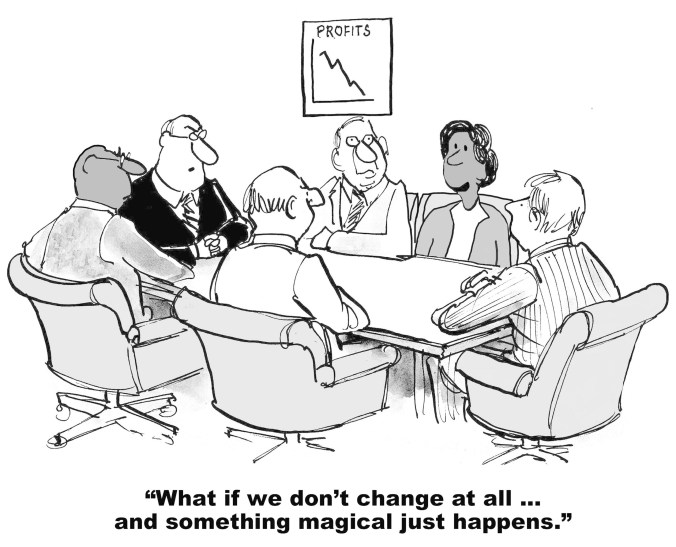
Cartoon of business people who want to avoid change.

10 THINGS SUCCESSFUL PEOPLE NEVER DO AGAIN, Jim Rohn

Declining Business Sales

“Well, now we know what not to do.”

I recently read an article from Jim Rohn on this and thought I would share with you.  Please consider these 10 things when you make a mistake.

We all make mistakes, some more than others (reference to me). However, mistakes allow for an opportunity for growth, if we recognize the mistake and correct the actions and/or habits that caused it or them.

Successful people realize where they went wrong and the never go back there.  Here are 10 Things Successful People Do Again.  I have read these over and over in my quest to prevent the need to have to use them.

1. Return to what hasn’t worked.

Whether a job, or a broken relationship that was ended for a good reason, we should never go back to the same thing, expecting different results, without something being different.

2. Do anything that requires them to be someone they are not.

In everything we do, we have to ask ourselves, “Why am I doing this? Am I suited for it? Does it fit me? Is it sustainable?” If the answer is no to any of these questions, you better have a very good reason to proceed.

3. Try to change another person.

When you realize that you cannot force someone into doing something, you give him or her freedom and allow them to experience the consequences. In doing so, you find your own freedom as well.

4. Believe they can please everyone.

Once you get that it truly is impossible to please everyone, you begin to live purposefully, trying to please the right people.

5. Choose short-term comfort over long-term benefit.

Once successful people know they want something that requires a painful, time-limited step, they do not mind the painful step because it gets them to a long-term benefit. Living out this principle is one of the most fundamental differences between successful and unsuccessful people, both personally and professionally.

6. Trust someone or something that appears flawless.

It’s natural for us to be drawn to things and people that appear “incredible.” We love excellence and should always be looking for it. We should pursue people who are great at what they do, employees who are high performers, dates who are exceptional people, friends who have stellar character, and companies that excel. But when someone or something looks too good to be true, he, she, or it is. The world is imperfect. Period. No one and no thing is without flaw, and if they appear that way, hit pause.

7. Take their eyes off the big picture.

We function better emotionally and perform better in our lives when we can see the big picture. For successful people, no one event is ever the whole story. Winners remember that—each and every day.

8. Neglect to do due diligence.

No matter how good something looks on the outside, it is only by taking a deeper, diligent, and honest look that we will find out what we truly need to know: the reality that we owe ourselves.

9. Fail to ask why they are where they find themselves.

One of the biggest differences between successful people and others is that in love and in life, in relationships and in business, successful people always ask themselves, what part am I playing in this situation? Said another way, they do not see themselves only as victims, even when they are.

10. Forget that their inner life determines their outer success.

The good life sometimes has little to do with outside circumstances. We are happy and fulfilled mostly by who we are on the inside. Research validates that. And our internal lives largely contribute to producing many of our external circumstances.

Everyone makes mistakes…even the most successful people out there. But, what achievers do better than others is recognize the patterns that are causing those mistakes and never repeat them again. In short, they learn from pain—their own and the pain of others.

A good thing to remember is this: pain is unavoidable, but repeating the same pain twice, when we could choose to learn and do something different, is certainly avoidable. I like to say, “we don’t need new ways to fail….the old ones are working just fine!” Our task, in business and in life, is to observe what they are, and never go back to doing them again.

TOUGH DECISIONS MAKE GOOD LEADERS

tough decisionsI often wonder why people (especially leaders) struggle in making decisions.  Even the smallest or minute decisions seem to derail some people.  These are people who hold key positions within an organization, hired to drive results, and advance the organization.  Like many of you, my career has been filled with leaders who will not make timely decisions.  In fact, one of the most common methods is to ignore or put off the request for a decision. This has caused great frustration over the years.  A leader’s inability to make decisions cost jobs and profits.  It creates embarrassment and the inability to attract and retain excellent talent.  So why do many leaders struggle making decisions?  I spent some time thinking about this over the last few days and concluded it comes down to this

The decision we make today will affect the outcome of tomorrow. So if I don’t make a decision, I am not responsible for the outcome.

That’s it!  People don’t want to be responsible for the outcome of their two roadsactions.  They fear their decision will be wrong or make people mad.  You see, many leaders see their position as a popularity contest.  So when unpopular decisions must be made, I’ve seen many leaders delay or ignore the situation in order to maintain their popularity. Eventually these decisions must be made and many communicate them through other leaders or sources.  General Colin Powell said, “Trying to get everyone to like you is a sign of mediocrity. You’ll avoid the tough decisions, you’ll avoid confronting people who need to be confronted, and you’ll avoid offering different rewards based on different performance because some people might get upset.”  

My career has been littered with many mediocre and bad leaders.  All have one thing in common.  They wanted people to like them and were willing to postpone and avoid tough decisions and hard conversations to ensure the relationship remained intact.  The great financier and Oklahoma State University Booster and COWBOY FOOTBALL supporter, T. Boone Pickens once cautioned: Don’t fall victim to what I call the ‘ready-aim-aim-aim-aim syndrome. You must be willing to fire.” Make a decision and act on it. That is what GOOD leaders do!

How does one make decisions?  How do you get the courage to make those tough choices and decisions even if they won’t be popular?   Here is a four-step process for making choices and decisions.

  1. READY, FIRE, AIM – If you follow my post or have ever read my blogs, this phrase should be familiar to you.  My philosophy is a wrong decision is better than no decision!  At least I made a decision.  I understand the responsibility to deliberate and become educated on the information or situation.  However, I believe instinct and intuition (my gut feeling) are very good indicators of what I must do.  Most times, the information has been available to us for many days or weeks prior to the choice and decision having to be made.  We know what is right and what must be done.  The great leaders act with limited information.
  2. BE CONFIDENT – I heard John Maxwell say, “Don’t waste time and energy second-guessing yourself.” Leaders must not look back on the decisions.  They must be confident in their decision and move on, regardless of the outcome.  I simply make the decision and move on.
  3. REMEMBER LEADERSHIP IS NOT A POPULARITY CONTEST – Leadership is not about friendships, but rather RELATIONSHIPS!  Our position of leader requires us to build relationships in order to create trust and ultimately influence for performance.  Friendships cause us to make decisions based on our desired friendship outcome.  We tend to allow friends to get away with more and we are less likely to have those difficult conversations.  Relationships allow us to be open and honest and create an atmosphere to make those difficult choices and decisions. Colin Powell said, “Sometimes leadership means pissing people off.”  I believe I have to make the right decision even if it is unpopular.
  4. TAKE RESPONSIBILITY THROUGH HUMILITY – Be responsible for your choices and decisions.  You’re the leader and you made the decision based on the information available at the time and on your instincts and intuition.  You are a leader because of your passion.  “Once you have a burning desire and you live in purpose with that desire, decisions come quickly and easily and seldom if ever will you change your mind.” ~ Napoleon Hill.  However, if the decision or choice didn’t work out as planned, there will be grace for the humble leader.  I heard it said once, “With pride, there are many curses. With humility, there come many blessings.”

choicesMaking even the smallest and inconsequential of decisions can seem difficult.  However, I’ve found following these four steps simplifies the process.  I can’t tell you that every decision will be the right one.  But I can tell you that your employees and the people that follow you will respect you for simply making a decision.  All leaders must make decisions.  However, effective leaders, the one’s that have success and influence others, make decisions quick and with bold confidence.

EMBRACE THESE FIVE PRINCIPLES AND LEAD SUCCESSFULLY

Success, what does it look like?  I get ask this question in many different ways.  Many ask what career steps I took to get ready for my current position as VP.  Others ask what it takes to become an effective leader.  Some have even asked what specific steps did you take to move up in your career.Fotosearch_k8316178

I recently spoke to several groups at the EHS Seminar for the Texas Chemical Council in Galveston, TX.  During a break, I was asked by a young professional what specific steps he could take to help him achieve his goal of VP.  I thought about that for a while and realized there were no real organized steps, but rather there were principles I embraced and embodied as a person and professional.  Let me share those with you.

  1. WORK/LIFE BALANCE – I have always put my faith and family above my job.  That doesn’t mean I haven’t worked seven days a week and 1 4hr or more days.  I have in fact done that and still do at times.  However, I’ve found that when I correctly balance my faith, family and work, my overall joy increases with my family and those I encounter. I’m happier at home and at work and I accomplish more and I become more efficient.  For many (including myself) work is satisfying and gives us a purpose and since of accomplishment.  However, without our faith and family, what good hard work?
  2. PASSION – I am so tired of hearing professionals tell me how much they hate or despise their jobs or situations.  If you hate what you do, THEN LEAVE!  Find a job you love, something that you can achieve and accomplish greatness.  Something that makes you happy.  Passion fuels your will power as a leader. Without it, you’ll lack the vigor to drive change and overcome obstacles. Without passion you quit!  By finding and following your passion—you’ll end up becoming a more dedicated, productive person.  A person who is happy, satisfied and content.
  3. EXCEED EXPECTATIONS – Expectations are the core of everything we do and everything that gets done.  Meeting expectations is what people do.  When you go into an annual review and meet expectations you receive an “average” rating and probably an “average” raise.  HOW BORING!  Average is boring, everyone is average. If you want to separate yourself from average, then you must “exceed expectations”! Exceeding expectations creates excitement.  It increases results in personal and company growth. Exceeding expectations sets you apart from everyone else. It also ensures you value people. When you value people you can accomplish anything.
  4. CHARACTER – Character is who you are inside portrayed through your actions and behaviors on the outside.  Character is who you are and who you are determines if people will follow. If people follow, then you can influence them, if you can influence them, then you can lead them! Your Character determines your reputation. Your reputation is built upon who you are internally, because that is what ultimately comes out and what people see.  Abraham Lincoln said, “Character is the Tree, Reputation is the Shadow.”Focus on being better on the inside than the outside, over time you will become better on the outside.
  5. BE HUMBLE- Leaders are typically those who have ambition, are very talented and confident when making decisions and interacting with people. But most of us don’t think of leaders as humble or describe them with the word “humility”.  Fotosearch_k16410884In fact, I think most leaders shy away from humility because they feel it is a sign of weakness or self-doubt. I totally disagree. I think a humble leader is one who has wisdom and self assuredness, someone who is not afraid to admit a mistake or that they might not have the best solution or answer.  Humility is the opposite of Pride. Ezra Taft Benson said, “Pride is concerned with who is right, humility is concerned with what is right.”  Humility does not come easy. We all want people to look up to us and think we have the answers and know the way. Benjamin Franklin once said, “there is perhaps not one of our natural passions so hard to subdue as pride. Beat it down, stifle it, mortify it as much as one pleases, it is still alive. Even if I could conceive that I had completely overcome it, I should probably be proud of my humility.”  The great college basketball coach John Wooden often told his players, “Talent is God-given. Be humble. Fame is man-given. Be thankful. Conceit is self-given. Be careful.”  C.S. Lewis said this, “Humility is not thinking less of yourself, it’s thinking of yourself less.”  

Follow these five (5) principles and I suspect you will be a successful leader, thus allowing you to grow professionally.  Remember it not always the job, money or position that indicates success.

HOW TO KEEP A POSITIVE ATTITUDE IN AN UNCERTAIN ENVIRONMENT

What a week!  This has been one of unexpected personnel change.  Being a senior leader in the oil and gas services industry, I’ve learned to be flexible.  The current market has created a daily sense of the unknown.  It seems every day I’m walking through a jungle.  Mired deep into the unknown.  Everyday seems to be an adventure to maintain a positive attitude. Sleepless nights are normal.  If five hours of good REM sleep is achieved, I am satisfied and elated.  Worry and anxiety become a normal routine. Our attitudes can take a big hit in an uncertain environment.

However, it doesn’t have to be that way, because we have control over our thoughts and attitude.

ATTITUDEFotosearch_k23073832

Attitude is dependent on your feelings toward something, someone or a situation.  Each person has an inward voice that encourages either self-promotion or self-defeat. Yes, there are some things that happen beyond our control. We all experience disappointment, heartache and difficult situations. However, what we do have control over is our response. Someone once said, “it’s not a matter of what’s happened to you, but rather how you respond to what’s happened.” It’s important to note here, there is a distinct difference between a response and a reaction. A reaction is “a feeling experienced in response to a situation or event.” Reactions are often quick, emotion filled responses. A response, on the other hand, involves more reason. It is a thoughtful, more appropriate answer to a certain situation.  Worry and anxiety will create the negative attitude and the inability to properly view the situation.  It creates a cloudy view.  In doing so, we are unable to properly asses the situation and take the necessary steps to correct it.

WHAT TO DO

So how does one keep a positive attitude and maintain their sanity in an uncertain environment?  I think the answer is easy, but the reality is hard.  As a person of faith, I personally look for my strength through my Lord, Jesus Christ.

However, I supplement my faith through these six (7) practical principles;

Insomnia

  1. STOP, What just happened? I get an email.  There have been personnel changes.  Your phone rings, informing you of something negative. Things are going downhill fast. You’re in a tail spin, making reactive decisions that, unfortunately, compound the problem.  Things are said, actions are taken and regret begins to set in.  What do you do?  Take some time to just step back from the problem and think. This will enable you to rationally deal with the issue at hand, instead of emotionally reacting. Just remember, you don’t have to do anything.
  2. When things go in a direction I didn’t expect, I turn to prayer.  Prayer creates a mindset of humbleness.  Worry and anxiety are turned over to him. I am reminded the circumstances are out my control, why worry and be concerned?
  3. Stick with your goal. Regardless of the situation, stick with your goal and what you know. When trouble hits, it tends to steer our focus off from where it should be. When a pilot encounters trouble, they immediately move into a systematic process to try and solve the problem.  However, they are focused on the goal of landing the plane safely. If they lost sight of their goal, disaster would certainly be imminent. One of the best things to do is to write out your goal(s).  Write out what steps are needed to achieving them.
  4. Analyze and Identify a solution. Sticking with the example above. The pilot will analyze the problems and determine the best solutions.  He/she is not sitting idly by, but rather analyzing the problem and aggressively identifying solutions and next steps.
  5. Surround yourself with encouragement. We all need encouragement.  Especially in a time when situations don’t go our way.  I’ve learned if I continue to dwell on the negative, worry will begin to take over creating a slippery slope downward.  My attitude changes and I have a negative affect on all.  When our backs are against the wall, we must surround ourselves with those who love and care for us and who will encourage our next move.  I look to the scriptures for my encouragement and seek out the wisdom of those I trust.  The book of Psalms has always been a source of encouragement.
  6. Find the good. Count your blessings.  I have a new grand daughter.  My wife and I are a month from our 30th wedding Anniversary.  Things are great.  However, the negative began to creep in.  Was I next? What would we do?  My thoughts began to run wild.  I enjoy my job and my life.  How would it be without it? My thoughts controlled my analysis  I began to panic somewhat.  I immediately stopped myself and focused on the good things.  I have been here before. In 2008, I lost my job.  I was weeks from loosing my house.  I made it through that.  Spend time dwelling on the good things about your life or career instead of the problems. There is an old childhood song that says, “Count your blessings—name them one by one.” That’s great advice! Let your positive attitude develop from within as well as from without. This makes all the difference!
  7. This isn’t forever.“This too shall pass” is a common saying I typically hear from people in difficult situations.   Remember that difficult times are only a season.  Some are longer than others, however it is a season.  We all go through them.  Teddy Roosevelt said, “Do what you can, with what you have, where you are.”  There will be a future where circumstances will change and you will be on top of the mountain instead of down in the valley.

First Sun Light over Mountain Valley - Panorama.  Smoky Mountains National Park, Tennessee

I hope none of you will ever go through anything negative or experience uncertain times.  Unfortunately the reality is you will.  We live in uncertain times.  It is becoming the norm.  There will always be upheaval in life. This will create worry and anxiety and have a negative affect on our attitudes. However, how we handle these times and our reactions will determine the outcome with others. A good attitude in difficult times will encourage others.

Remember to STOP, PRAY, STICK , REFLECT, ANALYZE and IDENTIFY SOLUTIONS, SURROUND AND REMEMBER, THIS ISN’T FOREVER!

LEADER INFLUENCE LLC

Leader Influence.net is also Leader Influence LLC.  If you find the information presented on this blog helpful or intriguing, then Leader Influence LLC can take you further.  The attached brochure explains our services and our desires to INFLUENCE individuals and Teams.  Consider Leader Influence LLC next time you are looking for a trainer, speaker or coach.


leader-influence-2-2

GRACE ABOUNDS FOR THE STUPID

On February 23rd (which is today as I write this blog), my wife and I should be enjoying a very nice dinner at an all-inclusive resort in the fabulous Mexican Riviera Maya.We were to celebrate our 30th Wedding Anniversary. This was to be a time where we would reflect on the last 30 years, both the good and the bad. Our marriage hasn’t always been easy, but it hasn’t always been hard either. Through the grace of God and hard work from each of us, we have taken challenging situations and turned it into a wonderful union. Regardless, 30 years is cause for celebration!th-50

White sands, blue water, 80-degree temperatures and a high UV-Index…SHHHHHH, I can feel the sun on my face and hear the waves crashing. Well, that’s what we should be experiencing…but something horrible happened!


 MY passport did not have 6 months validity past the day of return. 

I looked at my passport several times throughout the last few months and I never snapped to it. Marlene (my wife) and I got my passport out of the safe a couple of weeks ago and thought we were good to go. We ASSUMED everything was good. Here’s the thing, my passport doesn’t expire until March 16th and we were to return on March 2nd. What’s the problem? As a last minute precaution, I decided to ensure that I didn’t need any other documentation before traveling. It was then that I noticed the requirement for a 6-month validity. Marlene began a frantic search for the truth and much to our dismay, we found it to be true!

I began to research options. One, I could expedite my renewal and go to the Regional Passport Center and spend the day in hopes of receiving my passport in time for travel. Or two, we could cancel the whole trip and get back a portion of the money already spent. The predicament was this; the deadline for the resort cancellation was the 19th (the same day we found out about the passport issue). FullSizeRenderSo, if we did not cancel that day, we would lose the full payment, but if we cancelled by 6 pm on the 19th, we would only lose a 2-night penalty. After much discussion, research and prayer, we decided to cancel. This was very difficult and disappointing decision. Imagine being in Oklahoma and only days from spending 8 nights on the beach in Mexico! Come on, anyone would be saddened!

To make the best of the situation, Marlene and I identified some things we learned from the experience. After all, if you’re going to mess up, you should at least learn something.

We did learn some things.  Here they are:

FROM MARLENE

The following points are directly from Marlene-

  • YOU NEVER “ARRIVE” -I thought I was beyond making this kind of mistake. The truth is, we are all susceptible to making careless errors.
  • THERE ARE ALWAYS 3 FINGERS POINTING BACK AT YOU – Don’t be quick to look down on others if they don’t have what you consider to be your strong points. Again, just because I pride myself on being organized and on top of things, doesn’t mean some things don’t occasionally slip or “fall through the cracks.”
  • I’M DISAPPOINTED! – There are times of disappointment. Be sad, but then put it into perspective. It’s a disappointment, not a tragedy.

When I came home, it was apparent that Marlene was disappointed and I could see she was dejected. Allow me however, to brag on her a bit. Even though it was a disappointing situation, she was not upset or hateful towards me. In fact, she was the complete opposite and tried to take responsibility herself. She felt liable in planning and working out the details of the trip. Although I truly believe I was responsible, her humility was appreciated.

FROM ME

Here is what I learned:

  • PAY ATTENTION TO DETAIL – You must pay attention to detail. Although I glanced at the passport several times, it never occurred to me to check the expiration date.
  • TAKE RESPONSIBILITY – One of the worst things you can do when you make a mistake is point a finger at someone else. Not only does this make you look like you’re skirting around responsibility, but also deflecting ownership will put someone else undeservedly in the “hot seat.” As soon as an error is brought to your attention, accept responsibility in the situation (despite whether or not it could have been avoided). Examine the issue and rectify the situation.
  • AVOID MAKING EXCUSES – Everyone has an excuse for things they’ve done wrong. Excuses don’t eradicate the fact that you made the mistake to begin with. Making an excuse isn’t any different than assigning the blame to someone or something else.
  • FIX IT -Once you realize you’ve made a mistake and acknowledged it, take steps to fix it. My mistake wasn’t anyone else’s responsibility, but my own.  I researched options to rectify the situation, but due to time constraints and the possibility of losing all our money, we chose to cancel the reservation altogether.
  • LEARN FROM IT – It you don’t learn from your mistakes, you wasted a valuable and sometimes expensive opportunity. Marlene and I took a lot of time discussing what each of us could do to prevent a similar situation from happening in the future.  We are in the process of renewing my passport and she has noted her own passport’s expiration date. In response, she has created a calendar notice to make sure her expiration date doesn’t slip past us unknowingly. Remember, every mistake is a valuable opportunity for self-improvement. Embrace the lesson learned and move forward.
  • MOVE ON – It’s okay to be sad and disappointed. However, don’t dwell or hold grudges. YESTERDAY ENDED LAST NIGHT! The mistake has been made, acknowledged, fixed and learned from. Realize that mistakes are inevitable and underneath it all, they can be truly beneficial.

I think the biggest lesson learned from this fiasco was that while we were let down, this situation ultimately brought us closer together and made us both realize how easily errors are made. The way we respond and handle stressful situations determines the outcome.

Although we dream about being on the sand, enjoying the sights and sounds of the ocean, great food and the overall culture of Mexico, we have sincerely moved on and feel at peace from what we’ve learned.

IMG_3367I love the couple that Marlene and I have become. There was a time in our early marriage where something like his would have involved blame and lasting grudges. However, with the leading of our Savior and the commitment we have made to one another, we were able to acknowledge our mistake and move on with a stronger marital bond.