INSIGHTFUL THOUGHTS ON CHANGE

Change Colorful Random Shapes

Change happens.  In fact, the only constant in life , is change.  I once told someone,

“The only things I can count on are; birth, death and change!”

If the world is going to continue, then change must occur, plain and simple.  As simple as it sounds, change is not easy.  There is always some stress involved, regardless if it’s our own choosing or not.

I recently changed jobs, which to many, was somewhat of a surprise.  I left a job that I was seemingly happy at.  I made a good living and had taken a company from virtually having no safety program to being a program desired by many competitors and even customers. It was a job I was successful at and generated a lot of personal and professional gratification.

The change meant leaving an area that I loved, a house I loved and more importantly, it meant leaving my daughter, son-in-law and my 5 month old granddaughter (my first grand baby).  So why the change?  I will provide a very simple answer at the end.

For me, job changes have been a way of life.  It typically occurs every 2-3 years.  My most recent change occurred after almost five years.  I’ve always looked at change as a positive thing.  I never want to become comfortable in a position or with a job.  I believe comfort creates complacency.  I was always working hard, looking for opportunities to improve. While the most recent change has open up the opportunity for many new challenges, it has opened my eyes to the stress it causes, not only in myself, but to those closest to me.

Change is now, handwriting with chalk on blackboard

I have come to realize all change leads to stress, even when it is of our own choosing, or is something we want.  You get a new job, buy a new house, get married, or simply buy a new car!  Well congratulations hot dog!  Now you have to wait 30 days for insurance, pay your mortgage, share your bathroom, and worry about when the first scratch will happen.

Sometimes we experience change unexpectedly, without warning.  You reach a point in life where you think you have it all under control, you hold all the cards, and everything is working just the way you want it.  Then the economy stutters, revenues decline, and you hear rumors of downsizing.   How are these changes going to affect you?  Will there be money to pay the mortgage, buy that first anniversary gift or even put gas in that shiny new vehicle?

Everything changes at some point. Whatever the change, we must adapt.  By adapting, you can learn to embrace change and conquer it for success.  However,  one must have the right mindset for accepting change.

Here are 13 quotes that will help put change in perspective.  Read these quotes and latch on to the ones that motivate and speak to your heart and mind.  Not all  of them will.  But I do think they can be beneficial when change, unexpected or planned, comes your way.

  1.  “I cannot say whether things will get better if we change; what I can say is they must change if they are to get better.” —Georg C. Lichtenberg

  2. “The price of doing the same old thing is far higher than the price of change.” – Bill Clinton

  3. “Change is the law of life. And those who look only to the past or present are certain to miss the future.” – John F. Kennedy

  4. “You never change things by fighting the existing reality. To change something, build a new model that makes the existing model obsolete.” – Buckminster Fuller

  5. “Your life does not get better by chance, it gets better by change.” —Jim Rohn

  6. “If you always do what you’ve always done, you’ll always get what you’ve always got.” —Henry Ford

  7. “When in doubt, choose change.” —Lily Leung

  8. “Change is inevitable. Change is constant.” —Benjamin Disraeli

  9. “Become a student of change. It is the only thing that will remain constant.” —Anthony D’Angelo

  10. “When we are no longer able to change a situation, we are challenged to change ourselves.” —Victor Frankl

  11. “You must welcome change as the rule but not as your ruler.” —Denis Waitley

  12. “Change before you have to.” —Jack Welch

  13. “Those who expect moments of change to be comfortable and free of conflict have not learned their history.” —Joan Wallach Scot

So why the change in jobs?  Because I am MOTIVATED by change and BORED by  redundancy!
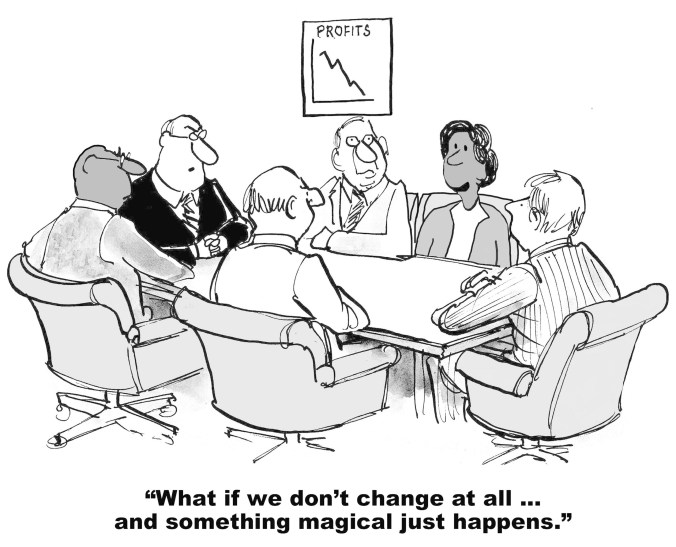
Cartoon of business people who want to avoid change.

HOW TO KEEP A POSITIVE ATTITUDE IN AN UNCERTAIN ENVIRONMENT

What a week!  This has been one of unexpected personnel change.  Being a senior leader in the oil and gas services industry, I’ve learned to be flexible.  The current market has created a daily sense of the unknown.  It seems every day I’m walking through a jungle.  Mired deep into the unknown.  Everyday seems to be an adventure to maintain a positive attitude. Sleepless nights are normal.  If five hours of good REM sleep is achieved, I am satisfied and elated.  Worry and anxiety become a normal routine. Our attitudes can take a big hit in an uncertain environment.

However, it doesn’t have to be that way, because we have control over our thoughts and attitude.

ATTITUDEFotosearch_k23073832

Attitude is dependent on your feelings toward something, someone or a situation.  Each person has an inward voice that encourages either self-promotion or self-defeat. Yes, there are some things that happen beyond our control. We all experience disappointment, heartache and difficult situations. However, what we do have control over is our response. Someone once said, “it’s not a matter of what’s happened to you, but rather how you respond to what’s happened.” It’s important to note here, there is a distinct difference between a response and a reaction. A reaction is “a feeling experienced in response to a situation or event.” Reactions are often quick, emotion filled responses. A response, on the other hand, involves more reason. It is a thoughtful, more appropriate answer to a certain situation.  Worry and anxiety will create the negative attitude and the inability to properly view the situation.  It creates a cloudy view.  In doing so, we are unable to properly asses the situation and take the necessary steps to correct it.

WHAT TO DO

So how does one keep a positive attitude and maintain their sanity in an uncertain environment?  I think the answer is easy, but the reality is hard.  As a person of faith, I personally look for my strength through my Lord, Jesus Christ.

However, I supplement my faith through these six (7) practical principles;

Insomnia

  1. STOP, What just happened? I get an email.  There have been personnel changes.  Your phone rings, informing you of something negative. Things are going downhill fast. You’re in a tail spin, making reactive decisions that, unfortunately, compound the problem.  Things are said, actions are taken and regret begins to set in.  What do you do?  Take some time to just step back from the problem and think. This will enable you to rationally deal with the issue at hand, instead of emotionally reacting. Just remember, you don’t have to do anything.
  2. When things go in a direction I didn’t expect, I turn to prayer.  Prayer creates a mindset of humbleness.  Worry and anxiety are turned over to him. I am reminded the circumstances are out my control, why worry and be concerned?
  3. Stick with your goal. Regardless of the situation, stick with your goal and what you know. When trouble hits, it tends to steer our focus off from where it should be. When a pilot encounters trouble, they immediately move into a systematic process to try and solve the problem.  However, they are focused on the goal of landing the plane safely. If they lost sight of their goal, disaster would certainly be imminent. One of the best things to do is to write out your goal(s).  Write out what steps are needed to achieving them.
  4. Analyze and Identify a solution. Sticking with the example above. The pilot will analyze the problems and determine the best solutions.  He/she is not sitting idly by, but rather analyzing the problem and aggressively identifying solutions and next steps.
  5. Surround yourself with encouragement. We all need encouragement.  Especially in a time when situations don’t go our way.  I’ve learned if I continue to dwell on the negative, worry will begin to take over creating a slippery slope downward.  My attitude changes and I have a negative affect on all.  When our backs are against the wall, we must surround ourselves with those who love and care for us and who will encourage our next move.  I look to the scriptures for my encouragement and seek out the wisdom of those I trust.  The book of Psalms has always been a source of encouragement.
  6. Find the good. Count your blessings.  I have a new grand daughter.  My wife and I are a month from our 30th wedding Anniversary.  Things are great.  However, the negative began to creep in.  Was I next? What would we do?  My thoughts began to run wild.  I enjoy my job and my life.  How would it be without it? My thoughts controlled my analysis  I began to panic somewhat.  I immediately stopped myself and focused on the good things.  I have been here before. In 2008, I lost my job.  I was weeks from loosing my house.  I made it through that.  Spend time dwelling on the good things about your life or career instead of the problems. There is an old childhood song that says, “Count your blessings—name them one by one.” That’s great advice! Let your positive attitude develop from within as well as from without. This makes all the difference!
  7. This isn’t forever.“This too shall pass” is a common saying I typically hear from people in difficult situations.   Remember that difficult times are only a season.  Some are longer than others, however it is a season.  We all go through them.  Teddy Roosevelt said, “Do what you can, with what you have, where you are.”  There will be a future where circumstances will change and you will be on top of the mountain instead of down in the valley.

First Sun Light over Mountain Valley - Panorama.  Smoky Mountains National Park, Tennessee

I hope none of you will ever go through anything negative or experience uncertain times.  Unfortunately the reality is you will.  We live in uncertain times.  It is becoming the norm.  There will always be upheaval in life. This will create worry and anxiety and have a negative affect on our attitudes. However, how we handle these times and our reactions will determine the outcome with others. A good attitude in difficult times will encourage others.

Remember to STOP, PRAY, STICK , REFLECT, ANALYZE and IDENTIFY SOLUTIONS, SURROUND AND REMEMBER, THIS ISN’T FOREVER!

REALLY, YOU LEAD PEOPLE?

Fotosearch_k15793683

I read an article the other day that touched on leadership behavior.  It sparked an abundance of memories, thoughts and questions that have rolled around in my head for many years.  Quite frankly it made me look deep inside of my soul and check my heart to ensure my actions and motives line up with my moral convictions.

Look, leaders are people.  In fact, many are good people.  There is a very small percentage of leaders that act and behave poorly.  I feel I’ve probably worked for more than most.  My career has been full of poor leaders.  Heck, there are a lot of my past and present employees that might say the same about me.

The whole reason I began my leadership journey was to do everything I could NOT to make the same mistakes or do the same things I have witnessed or gone through.

Through my experience, I have identified 9 things that define poor leaders.  Here they are;

  1. IT’S ALL ABOUT YOUNo it isn’t!  In fact, we probably don’t About.me_iconcare what you did or where you went.  It is about those you lead.  When every conversation and situation is about you, it limits the interaction and contribution of others.  I’ve had many leaders more concerned about how situations affect them, than the one(s) involved or affected.
  2. HEY BUDDY -Considering those you lead as friends.  Not good. Leadership is about relationships, not friendships.  When friends and buddies don’t perform we tend to “sweep” it under the rug or make excuses, rather than hold them accountable.  This creates descension and frustration with other employees.  Build relationships, not friendships.  I’ve seen many leaders lose credibility over the hiring or advancement of friends or relatives many times.  I am not saying you can’t hire employees from the past or those who supported and assisted you at other jobs.  I was the best man at my Director of EHS’ wedding 29 years ago.  However, I bet he will tell you that he is held to the same accountability level as anyone else.  In fact, I expect more out of him, than most.
  3. HORRIBLE LISTENER blah, blah, blah…….  This leader doesn’t care what you have to say.  They are only concerned with what’s coming out of his mouth.  Their EGO gets in the way.  Hey man, you were given 2 ears and 1 mouth for a reason.  You need to listen twice as much as you talk.  Give people a chance to say something.  Who knows, what they have to say might solve the problem.
  4. WHAT ARE YOU THINKING? -Poor communicators can reduce and harm aculture and frustrate employees quickly. Many employees complain about the lack of communication from leadership.  What are my expectations, Fotosearch_k10378786How is the company performing?, Will there be raises or bonuses this year?  As I coach leaders, I encourage them to have weekly or monthly communication meetings.  This is a time where all they do is communicate key information and allow employees an opportunity to ask questions.
  5. DON’T TEXT ME -Technology is great, but technology has created a diminishing environment of face to face communication.  How many times have you received a text or email and interrupted it as negative?  Texting and emails are very difficult to communicate a tone.  A face to face visit is the best way to properly communicate.  I can see your facial expressions and body language and I can react or change my tone or words to ensure effective communication.  If you can’t meet face to face, call them, and don’t leave a voice mail to cover your items.
  6. REALLY?Hear’s a thought……Get both sides of the story before you make a decision.  One of the most frustrating things for employees is when a leader makes decisions based on a one sided conversation.  One of the traits of a leader is to be open and accessible.
    However, that doesn’t mean you base your decisions on the conversations of one individual.  I found many times, my accessibility and openness has allowed individuals to voice their displeasure with a supervisor, rule or practice only to find out in my follow-up conversation the individual was disciplined or held accountable for failure to comply with or follow directions, etc.
  7. THAT WILL NEVER WORKBeing cynical is not a trait of a leader.  In fact, it is totally opposite.  I think cynical leaders feel threatened. They must discount or even put down a person’s ideas because they feel as if they are not a leader if they don’t have Fotosearch_k5253244the answer.  Cynical leaders say; “No, that’s not going to work” or, “I don’t know why we are doing this; this is stupid.”  Look, if something is stupid, then the leader needs to fix it.  If something is not worth doing or is going to create major problems, it’s your responsibility to facilitate other ideas.  Regardless, you must thank and encourage those who offer ideas and opinions, not BELITTLE them!

  8. THAT’S DISGUSTING! Just because you can say it, doesn’t make it right.  Foul language is wrong and unprofessional.   For some reason, leaders feel they have the right to use foul language and tell questionable stories in front of their staff or employees.  I recently had a leader use very disgusting language in reference to a football game. It stunned the group.  No one knew how to react.  I have had several occasions where leaders would use foul language in an email or text.  Regardless of the communication, it is WRONG!  Some have told me, “you have to talk in the language of the industry”. What?  Come on man!!  If that is the case, then we need to clean up the industry!  It doesn’t matter if you are playing, it is your normal language or if you are angry, foul language is wrong, no matter what!  Whether it’s anger, disgust or this is how you talk to your friends, you can’t bring it to the office.
    I can tell if a person has leadership qualities by the way they talk to others.
  9. YOU CROSSED THE LINE!Leaders who compromise their integrity for business or profits are FOOLS!   A lack of integrity from leaders doesn’t just annoy employees, it appalls them. In fact, when a leader shows a lack of integrity, employees become de-motivated.  When a boss breaks or fudges the rules, cheats, lies or indulges in behaviors that reveal a lack of moral principles, he loses respect. images7-220x147 respect, you can’t influence.  If you can’t influence, you can’t lead.  In addition, when a leader lacks integrity, he gives employees permission to do the same.  I’ve seen leaders compromise their integrity and moral values to be validated by others.  I have personally seen this take place and the destruction it causes.  A true leader will never comprise their moral integrity for validations.

Being a leader is about doing the right thing and leading by example. You simply cannot have one standard for yourself and one for everyone else. Treat people the way you would want to be treated.

If some of these sound familiar, then do something to correct them immediately.  The longer you continue the easier it is to continue.

Don’t Be a Liar in 2016, Identify Principles, Not Resolutions

2016_happy_new_year-wide


As you consider 2016, commit to what makes you better, not what makes you a liar.

Resolutions will make a liar out of you every time!  Instead, focus on the things you can control and achieve. It is all about your principles.

Here are 11 principles I am committed to in 2016.

  • SET WRITTEN GOALS –  Have WRITTEN goals that are achievable, but stretch you personally and professionally.  However, make sure you have some that are easy wins.  The easy wins motivate me to attack the more difficult one’s.
  • BECOME A BETTER COMMUNICATOR – Learn to listen more and ask great questions.  I had this on my list last year. Biggest issue I have.  I love to hear my own voice.  However, I found I can help more people by listening more than talking and engaging that person with relevant smart questions.  As a better listener, I can serve those I lead and company employees better and more effectively.
  • BECOME MORE ENGAGED – I continue to believe that every professional must be engaged in the work of those they lead, or as a safety professional, we must truly understand what people do, how they do it and what barriers exist.  You can’t influence if you don’t know how to add value!!  I put over 35,000 miles on my vehicle visiting locations and employees!
  • BE MORE PATIENT – Learn to be more patient with people and be more patient for the desired results.  Another challenge for me. Realize that it takes time to see results.  Leaders are leading to change a culture.  It takes time to change the way people think. Know what you want the end result to be and work steadily and patiently towards that.
  • BREAK DOWN BARRIERS – Identify what is creating friction.  Is it a person? a process?, lack of communication? Departments or individuals with competing agendas can slow or stall goals and affect company and individual performance.  Realize we are not in competition with each other, but rather we are in competition with the competition.  Be transparent, share information and help others succeed.  Zig Ziglar said;

You can have everything in life you want, if you will just help enough other people get what they want.”

  • BECOME RESILIENT TO FAILURE – Along the same thought process as patience, you must become resilient to failure.  beresilient-pocketcards-new1-1020x1020_4403_700x700Learn to fail forward.  Your approach to failure will have an impact on the outcome.  Embrace the failure and use it to gain success.

  • BE PROACTIVE – Become more aware of trends within the organization.  By listening to the talk and becoming aware of people’s actions, the words they choose and the trends within the industry, you can create or make changes to programs, goals and training that allows you to stay ahead of the “game”.  For Safety Professionals like myself, that means a reduction of risk resulting in less incidents.
  • TAKE MORE CHANCES -Ready, Fire, Aim!!! Doesn’t everyone in my group and company hear that a lot.  Just ask them.    I learned this term 25 years ago at another company. I believe if you don’t take chances, you won’t be successful.  John Maxwell says, “first always wins”.  Be creative.  Think differently to solve problems or make things better. Identify what needs to be done, DO IT and we will improve it.  If you never do it, you will never know the result.
  • NETWORK MORE – Networking is the single greatest activity you can do to increase your net worth.  My connection to an individual, put me in the position I hold now.  I now make more money and have the best job  I’ve ever had!  It is frequently said that “it is not what you know but who you know”.  It amazes my how many professionals do not make an effort to network.  I lost my job in November 2008.  It was through a former associate that I received my next job.  Networking is crucial for career advancement and recognition as a true professional or expert.  BE ACTIVE ON LINKED and keep your profile up to date.  I am consistently surprised (shouldn’t be) at how many professionals (especially sales) do not even have a LinkedIn profile.  You never know when you will need help and who can help!
  • VOLUNTEER/SERVE MORE – Become active in your community, professional organizations, church , etc.  JUST VOLUNTEER!!  I volunteer on a couple of boards, I am President Elect (President in second half of year) for my local professional organization, AVP for the Regional Professional Organization, speak for free at multiple organizations and conferences,  and volunteer my time with the local high schools in the OKC area.  I believe this builds character and humility while making others better.
  • INVEST IN YOURSELF – How can you lead others, if you don’t grow your yourself?  You can’t!!  READ,READ, READ…………….fiction and non-fiction.  Reading stimulates the brain and expands your creativity.  I use to hate to read, now I love it.  invest-in-yourself-600x300My goal is to read at least 1 new book per month.  Reading gives me a lot of my ideas and creates a sense of knowledge for solving most problems.  If I don’t know the answer, I read.  Commit to attending meetings, conferences and training that stretches you and provides a greater expansion of your personal and professional knowledge.

I quit making New Year’s Resolutions a long time ago. Ok, Ok, Ok, I will eat less fatty foods, cut down on the sweets (maybe) and exercise  more.  I never succeeded or followed through with many of my new year’s resolutions.  Instead, I’ve learned to identify things I would do daily, monthly or throughout the year to make me an overall better person.

That’s how I  came up with these 11 things.  This isn’t the first time I wrote these.  This has been my life for the last few years.  These 11 principles continue to mold and shape me and will make meFotosearch_k12215246 a better husband, father, GRANDFATHER (in April), professional, leader and overall a better person.

What about you? 

7 Keys to Becoming an Influential Safety Leader

7 Keys to InfluenceIt is my belief that the safety professional can have more influence than any other person within an organization. Think about it. Executives are typically in the office and seldom experience the field or the manufacturing daily work environment. Managers/Supervisors have assigned areas of responsibility, where they typically regulate a certain department or area.

The safety professional, on the other hand, typically upholds responsibility for the entire facility, region or area. Much of the workday is spent in the field or on the floor. Safety Professionals are expected to have a broad range of knowledge and an array of information concerning the business. In addition, they must have the ability to solve a wide spectrum of problems.

It is evident safety professionals have the ability to influence others more than any other position within the profession. The problem is that too many of us fall into the “authority” trap, where we think we can force compliance and the “0” injury campaign. So wrong! That used to be me. I thought I had the power and the authority to fix any problem. After six or seven jobs, I realized this was not the case. Rather, I’ve recognized the power of influence, it’s a trait that enables me to evolve as a strong and effective leader.

If you want to be a leader who has influence upon executives, manager, supervisors and employees, the key is to become valuable. When I reflect upon leadership, I think of John Csafetysign. Maxwell’s definition of leadership. He simply states, “Leadership is influence, nothing more, nothing less.” I have fully bought into this belief and I daily strive to increase influence. My desire is to influence others a little more each day. In my quest to increase influence, I have identified 7 Keys that will help create more authority as a safety professional.

They are as follows:

  1. Be firm but Fair – I learned this back in 1985 when I was in the academy for the Texas Prison System. I will never forget when I heard it for the first time. I was in a sweltering classroom listening to an old instructor when he said, “Inmates are people. Like anyone else, they respond to tone and attitude. If you want an inmate to respect you, you must be FIRM BUT FAIR with them.” This is an extra step you must take to become an influential, capable leader. Talk to your employees and listen to them. They will tell you why they can or cannot comply. Some people mistake rudeness as a sign of strength, however, it’s not even a substitute. Establish a high expectation for performance and hold others accountable. Observe the “big picture” because there might be something that keeps an employee from fully complying.
  1. Be Kind but not Weak – Do not mistake weakness for kindness. In my opinion, people are not weak when they demonstrate kindness. In fact, I think kindness is a leadership strength that has a positive impact upon others. Kindness is telling someone the truth, letting him or her know the consequences of their actions and laying everything on the line. Kindness is also about being open and honest. People will hear the truth if it is presented in a gentle and respectable manner. Remember, respect is achieved through the way we discuss and talk with others. Dealing kindly with people will generate respect ad allow you to influence them.
  1. Be Bold but not Annoying – It takes boldness to be an effective safety leader. In order to build influence with executives, managers or employees, you have to lead the way. You have to have your back exposed to the group. Such an idea can be expressed in the prison term “willing to feel cold steel,” although not literally I hope. Rather, you have to be the individual who isn’t afraid to challenge the status quo. You must be the first to identify and address problems, taking initiative and providing solutions. I love how Jim Rohn states, “Like the farmer, if you want any rewards at harvest time, you have to be bold and face the weeds and the rain and the bugs straight on.” Be known as a problem solver, not a problem creator.
  1. Be Humble but not Timid – You can’t get the “high life” by being timid. Some people mistake timidity for humility, but humility is a virtue; timidity is a downfall. It’s an affliction, although it can be cured. Humility is the opposite of pride. Ezra Taft Benson said “Pride is concerned with who is right, humility is concerned with what is right.” Humility does not come easy. In fact, I personally find it very difficult at times. We all want to be right, as well as our ideas and thoughts acted upon. We all want people to look up to us and think have the answers and know the way. However, we don’t always know what others are going through. Sometimes we don’t have all the facts or see the bigger picture. Be willing to admit when your wrong and you will gain respect as well as influence in doing so.
  1. Be proud but not Arrogant – It takes pride to build your ambitions and pride in a cause or accomplishment. The key to becoming a good leader is to be proud without being arrogant. Do you know the worst kind of arrogance? Arrogance that stems from ignorance. It’s intolerable. If someone is intelligent and arrogant, it can be tolerated at best. To be ignorant and arrogant, that’s unbearable.
  1. Be funny without being Goofy – In leadership, we learn that it’s OK to be amusing but not silly, fun but not imprudent. Be of good cheer and it will rub off on others.
  1. Be a Realist – Deal in truth. Delusion creates agony. Simply accept life as it is, even the drama that comes with it. Enjoy the ride; it will be fascinating!

Showing-direction-influenceOur ability to influence others is the core of our profession. Influence is achieved by earning the respect of those you come into contact with. We have a unique opportunity to influence at all levels within the organization. The 7 Keys listed will help create an individual atmosphere where influence is increased. After all, our ability to influence within the safety arena could result in a life or death consequence.

CHANGE…..DOESN’T HAVE TO HURT!

Let’s face it; change can be both difficult and frustrating. People like doing what they’ve always done and they don’t want anyone to tell them different! For those of you who utilize social media, I think you’ll agree with me that each time Facebook changes its layout; there is a general sense of panic from its loyal users. Updates are meant to act as an improvement to the program, but this is often overlooked. People don’t want to put forth an effort to become acquainted with a new Facebook layout; they simply want it to look as it did before. This same mentality can be translated into the workforce, change is often viewed as terrifying experience and for some, it takes a considerable amount of energy to accept unfamiliar territory.

However, change is to be expected. In fact, if it doesn’t happen, it can have a negative impact on business and professional growth. On the other hand, change doesn’t have to hurt. Our personal leadership will set the tone and the expectation for others to follow. I believe that if we have the right attitude and we take a humble approach, change will become easier. Winston Churchill once said, “Attitude is a little thing that makes a big difference.” Our leadership attitude, along with how we approach people and situations will create a lasting effect on our efforts and end results.

I often recall (and remind myself) of the constant resistance that I experienced when I first began to implement changes within my current company. It seemed as if everything that needed modifications, often required long and tedious conversations beforehand. Now that some of the accepted changes have occurred within the company, I occasionally hear employees comment about how it has directly related to their positive attitude. The brilliant writer, C. S. Lewis said, “Blessed are the flexible, for they will never get bent out of shape.” As I have identified and collaborated with other employees, I have realized that not only did the employees need to be flexible and open, but so did I. In fact, I found that my flexibility to push and pull back has made the path of change better. Not easier, but better.

As leaders, we must find ways to overcome resistance instead of being smothered by it. I came across these six steps in a blog by the John Maxwell Company staff writer. They are used everyday and I have found them useful in ensuring that we, as employees, stay the course.

  1. BE AWARE THAT MOTION CREATES FRICTION– Galileo discovered that moving objects create friction whenever they interact with a rigid surface. Leaders launch forward motion, but employees stubbornly resist change because they dislike uncertainty. Stay the course; be aware that you will encounter friction with new ideas and or suggestions.
  1. REMEMBER THE 20-50-30 PRINCIPLE– As rule of thumb, 20% of people will support change, 50% will be undecided and 30% will resist. Casey Stengel said this, “The secret of managing is to keep the guys who hate your guts away from the guys who haven’t made up their minds yet.” Don’t try and sooth the 30%. All you will do is stir up a hornet’s nest. Instead, seek to convince and “woo” the 50% sitting on the fence. At the same time, encourage the 20% who are likely to help convince others and lead the drive for change.
  1. PROVIDE A CLEAR TARGET– I endure great pain to take long hikes and steep climbs to enjoy the scenic views from the top of a mountain or bluff. Without this reward, would I be so inclined to huff and puff and feel my legs burn? Probably not. A leaders duty is to remind employees where we are heading and what lies around the bend. Without a sense of purpose or vision, employees will loose heart and become discourage and resistant. Remember this, “Without a vision, the people will perish”.
  1. PROMISE PROBLEMS– Remind employees the rewards of change, but don’t mislead or sugar coat the difficulties. The real truth of change is things will get worse before they get better. Liken change to fixing your golf swing; altering your stance, swing and grip is award at first. In fact, it is easy to revert back to our previous bad habits, especially when we don’t see immediate results. However, if you stick to it, your shots become straighter, go further and you stay out of the woods and your score improves. Stick with it……….the rewards are great!
  1. INVOLVE EMPLOYEES IN THE PROCESS OF CHANGE– Change can make people feel uncomfortable and out of control. By including them in the process, they feel less vulnerable or helplessness during the process. It also gives them “skin in the game” and they begin to own the change. In fact, employee involvement will help convert the 50% and some of the 30% (refer to #2 above). Get people involved and listen to their ideas. Hey, try some of them; you might be surprised at the problems employees can solve. As leaders, we must be flexible in our thoughts and ideas and allow employees to make suggestions and give honest feedback. It’s ok if it is not the ideal way we would do something. Remember, “Blessed are the Flexible”. Be flexible, challenge your thinking.
  1. CELEBRATE SUCCESS– Regardless how we lead, change will wear you out! It takes a lot of energy and effort from everyone. In fact, it can just flat wear you out!! So, we have to remember to celebrate the small successes along the way. Make sure employees know we recognize the effort and strain and that we are appreciative of their efforts. This is a very important part to overcoming the stress of resistance.

Someone once said, “Change is inevitable,” and it happens regardless of our thoughts and feelings. We can choose to either embrace it or resist it, and our employees have the same options. Unfortunately, there will be those who prefer to resist change and chose not be a part of the future. That’s fine and as the saying goes, I hope “the door doesn’t hit ‘em on the way out!” Trust me, the company will benefit from those who do not oppose change.

Additionally, change doesn’t have to hurt. It may be a bumpy ride, but if you are diligent to remember these six things and implement them, they will make the bumps bearable. Utilizing these six nuggets of wisdom will help you overcome resistance to change, as well as lead others who are hesitant to leave their old habits and former ideas. Remember, everyone is watching and listening. Consequently, our attitudes, behaviors, and responses will greatly affect our employee’s abilities to embrace change.

CHANGE STARTS WITH US. LEAD WITH A HUMBLE HEART THAT IS WILLING TO FINISH THE RACE. THERE ARE GREAT REWARDS AT THE FINISH LINE!