All You Are Is Full Of Hot Air! Moving From Words To Actions

c700x420Last Saturday morning I stepped out on my apartment balcony and saw several hot air balloons passing overhead. In fact, one was lifting off from the field across from the complex. As if I were a little kid, I excitedly called my wife over to show her the activity. She reluctantly came, and I began telling her how I was going to buy a hot air balloon, and I would take her up on a beautiful evening flight with a bottle of cabernet, and we would gaze into each other’s eyes into the evening sunset.

She looked at me and said, “All you are is a bunch of hot air.”

Hey wait a minute, I was romantic. Maybe that is why I was “full of hot air.” I am not well known for my romantic side.

Has anyone ever told you, you were full of hot air? If so, you are not alone. I think this post will help you understand why our words should not be hot air but rather backed up by the foundation of our actions.

It came to me that day while watching hot air balloons drifting overhead, that our words have a great impact on those we speak too. In fact, I realized that our words indicate our intended actions, but the follow-through is more important than any word in our vocabulary.

My intention is not to be a know it all, however, I think I know it all. If you don’t know it, then how will you solve it? Another, a fault I have is answering before I thought it out or committing before I realize what I committed to.  Had anyone ever say that to you? I hear it often because I talk too much. Regardless of the situation, I have the answer, and you will listen to it. My intention is not to be a know it all, however, I know it all. If you don’t know it, then how will you solve it? Another, a fault I have is answering before I thought it out or committing before I realize what I committed to.

I hear “you’re full of hot air, or that’s a lot of empty hot air coming from your mouth,” often. Probably because I talk way too much and have to get in everyone’s business to resolve everyone’s problems. Another, a fault I have is answering before I thought it out or committing before I realize what I committed to.Had anyone ever say that to you? I hear it often because I talk too much. Regardless of the situation, I have the answer, and you will listen to it. My intention is not to be a know it all, however, I know it all. If you don’t know it, then how will you solve it? Another, a fault I have is answering before I thought it out or committing before I realize what I committed to.

I know what you’re thinking, stop rambling and tell us what you are going to tell us.  Ok, Ok, got it. Here you go:

  1. Our actions build trust – Without trust, there is no influence, and without influence, there is no leadership. Deliver on what you say, and you begin to create trust.
  2. Our actions show personal responsibility – When, what we speak, is backed up by what we do, people begin to recognize the responsibility we have for achieving the desired outcome.
  3. Our actions create our reputation – You are known by your behaviors and the work you do. Make sure the things you say are truthful and backup by your actions.
  4. Actions show commitment – When we act, we validate our words, thoughts, and ideas.  We move from the verbal to the physical. Actions move our verbal commitment to the tangible result.

Our words are essential. They lay the foundation of our beliefs and our desires. However, they are merely words, actions prove our intentions and reflect our beliefs and desires.

Choose your words carefully, they must be backed up with actions.

stuffyoushouldknow-podcasts-wp-content-uploads-sites-16-2015-08-hotairballoons600x350

6 Ways To Add Value To Your Team

Business team shwoing thumbs upI don’t think there is ever an instance where one person is the team, or where one person is responsible for the success or failure of the team. Whether at work or within the family, I believe it always involves a team effort.

As I continue my leadership journey, identifying areas of improvement within myself and when coaching leaders, I am convinced success is always a team effort. Sure, there is always someone who leads the way, but I believe they are supported by the team who is like-minded and supportive of their ideas and efforts.

Experiencing what it really means to add value to a group, I have identified 6 ways to increase the value as a team member.

Here they are:

  1.  SUPPORT THE VISION – Support the vision and direction of the team leader or team itself.  You must be honest with your thoughts and ideas, but in the end be a verbal proponent of the team and the direction the team wants to head.
  2. RESPECT OTHERS – You must comply with the ideas and or concerns of others. Never just dismiss what others have to say or the direction they believe in.  But rather, listen to what they have to say and consider the overall impact it has on the team goal.
  3. BE PREPARED TO GO ABOVE AND BEYOND – Teams need members that are willing to go above and beyond.   You might have to do more, take more and work more.  Be prepared to give it your all to the success of the team.  Be a better planner.  Be a better goal and objective setter and by all means be prepared to hold yourself accountable!
  4. BE THE EXPERT – Great team members are informed by team members.  The best performing team is the most knowledgeable team.  What is our objective?  What do we want to accomplish? What is my role?  Remember, information is knowledge.  The more knowledgeable the Team is, the more likely they are to be successful.
  5. CELEBRATE SUCCESS – Most do not do this well. How often have you achieved a goal and there was no fanfare? No celebration?  It almost seemed success was expected.  Maybe so, however, I believe celebrating your successes (regardless of how small) is the key to future encouragement.  Honestly, don’t be afraid to tell others how much you appreciate their effort and help to accomplish the team’s goals and objectives.
  6. BE A GO TO PERSON –  People appreciate those they can go and talk to.  Individuals who can simply listen and those who convey confidence and support and who are viewed as discrete and trustworthy?  A person that you can bounce off ideas and concerns and know they will simply be heard.

Consider these when working with a team. Only small visions can be achieved without a team. However, one can achieve endless visions with active teams!

Creative Business Team Stacking Hands In Huddle

What Message Are You Sending? PART 1 of 3 – 10 Rules and Etiquette for Crafting and Sending Effective Emails

email 2You’ve been there.  You get an email accusing you of some action or lack of action. The tone is rude and inappropriate.  The sender includes several people, many who have no reason to be involved. As you read what is written, the words spark enraged anger from deep within your soul.

You immediately react by hitting “Reply All.”  In fact, you want to vindicate yourself, so you “Bcc” your supervisor. Through your rage, you unleash a barrage of words that support your position.

Immediately, after hitting the send button, you receive a text from your boss.  Yes!  He wants to congratulate you on an excellent response!  Only when you open the text, it says “meet me in my office first thing in the morning.”

Emails and texting, perceived in the wrong way, can lessen or eliminate the influence email-logoyou have with your staff or groups. The relationships you spent months or maybe years to build and foster are now in jeopardy.

Email and texting should never be a substitute for face to face communication or phone conversation. However, if crafted properly, these can be useful in reinforcing your ideas and increasing your influence.

In part 1 of my 3 part series, I provide 10 rules and etiquette for crafting and sending using emails.

I find these very useful and productive to lessen the chance of responding in a destructive or unprofessional manner.

EMAIL

When preparing or an email consider the following 10 suggestions:

  1. First, consider a face-to-face or phone call before sending an email. 
  2. Send the email to those that absolutely need to know.  
  3.  “CC” people for information only.  “CC” responses should only be sent if the data reinforce or add additional pertinent information.
  4. Make sure the “subject” accurately depicts the content.
  5. Content must be specifically related to your “TO” group. Be precise, concise, and clear.
  6. Begin the email with a positive statement. Sets the tone for the responses.
  7. Continued disagreement or confusion, set up an in person meeting, conference call or video chat.
  8. READ IT BEFORE YOU HIT SEND AND THEN READ IT AGAIN. Read and re-read your email.  Make sure your grammar, spelling, and choice of words portray the intended tone and message.
  9. Emails should NEVER be used to reprimand, counsel or address disagreements. 
  10. When in doubt…….have a face-to-face conversation.

Real Integrity


I was talking with a group of people the other day when one of them began talking about how much integrity they had and how they strive to do the right thing always. That statement caught me by surprise because I know this person and have had many discussions concerning their lack of integrity. It made me realize two things.

  1. If you have to tell someone you have integrity, you probably don’t.
  2. Authentic integrity is built within a person’s character through their actions.

Genuine integrity is the foundation of a person’s credibility. Credibility creates confidence, and that confidence allows influence.

“Integrity is what we do, what we say, and what we say we do” – Don Gater.

Someone once said,

“You are already of consequence in the world if you are known as a man of strict integrity”.

That’s how essential integrity is in your personal life. In fact, if you have nothing else, authentic integrity will catapult you past everyone else.

Dwight Eisenhower said, “The supreme quality for leadership is unquestionably integrity. Without it, no real success is possible.”

I agree with Eisenhower. I cannot emphasize enough about the importance of having genuine integrity if you want real leadership in your life.

Integrity gives you so much credibility, trust, confidence, influence and much more.

Be a person of integrity and be a person who people want to follow.

Trust, The Glue That Bonds Relationships

“The best way to find out if you can trust somebody is to trust them.” ~Ernest Hemingway

According to Steven Covey, “Trust is the glue of life.  It’s the most essential ingredient in effective communication.  It’s the foundational principle that upholds all relationships”. Trust is crucial in the leadership process.  In fact, trust is required for effective leadership.  Trust can be described simply by comparing it to pocket change.  Every right decision puts change in your pocket.  Every poor decision takes change from your pocket.  The key is to increase your pocket change, rather than always paying it out.  Sure we all make mistakes. And each mistake cost us some coins from our pocket.  However, employees are tolerant of mistakes as long as we are transparent, quick to humility and strive to regain their confidence.

In his book, Leadership 101, John Maxwell shares three qualities a leader must exhibit to gain trust; competence, connection and character.  Violate any one of these three qualities, and you will lose the trust of those who follow.  Trust is doing what’s right because it’s right.  Mackey and Sisodia state in their book, Conscious Capitalism; “the right actions undertaken for the right reasons generally lead to good outcomes over time.”  I don’t think anyone can remain a leader if he or she continues to make poor decisions and break the trust of employees.  When we break trust, we damage the relationship. Relationships can be repaired, but with much work and effort.

In fact, a leader can’t be a leader if there is no trust because trust leads to influence.  If people don’t trust you, you can’t have influence.  Without influence, you can’t lead.

Build sincere relationships and out of your sincerity, will come trust. Only then will you be able to influence and achieve effective leadership.

trust-fall

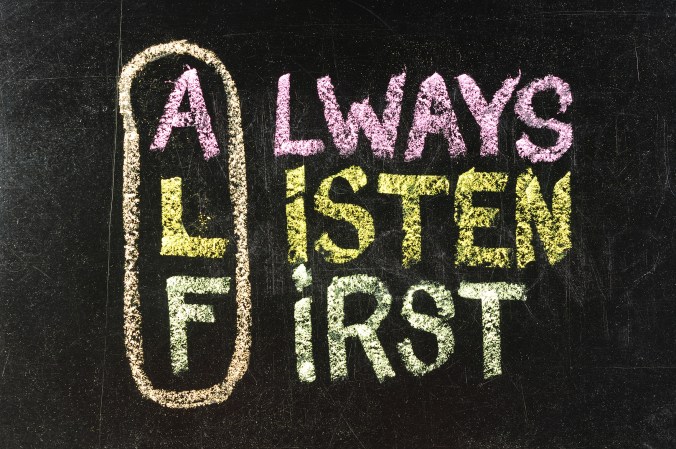
Listen First, Listen Second, Speak When You Understand

isten firstListening, a task I struggle at. As a coach, trainer and speaker, I tend to be a problem solver. In fact, I think I’m so good, I’ll finish your sentence or thought for you. Why should you waste valuable oxygen. However, I’m finding the oxygen we breath gives a person the ability to take a breath and speak their thoughts, concerns and ideas. In fact, when I allow people to finish their sentence and thoughts, I find many provide valuable solutions or ideas. So as I continue to learn how to control my attention and listen more, I am finding that; from listening comes knowledge and from knowledge comes a true understanding. From understanding comes the wisdom to support or help. And from wisdom, comes the ability to solve problems. The common saying; “God gave you two ears and one mouth for a reason”, continues to be true throughout the ages. Learn to listen, and you will be more successful.

READY, FIRE, AIM, The Initiative Concept for Leadership Abundance and Success

Ready Fire AimIf you know what to do, then just do it!  I could probably stop right there and have the shortest blog I’ve ever written.  But that would be boring.

As a leader, one of the most frustrating things is to have someone on my team not take the initiative to make things happen.  Instead they sit back and wait for direction, or constantly need my approval that their path or ideas are right.

I want people that are willing to take risks, learn from their mistakes and accomplish what they never thought could be done.  I encourage and expect my staff to embrace the idea of READY, FIRE, AIM!  A concept I learned years ago and I have refined recently.

Let me break the term down:

  • READY – Identify what needs to be accomplished and evaluate what it takes to fully and completely accomplish the task or idea.
  • FIRE – Go do it!  Don’t wait.  Be the swoosh in NIKE and “Just Do It.”  For my inner circle, there are very few times where this concept wouldn’t apply.
  • AIM – Once you “Do It”, then tweek as needed.  If you did your due diligence in the READY phase, there should be very little need to correct things.

These three simple words can create extreme success in your leadership and success in the workplace.

Here are three examples of people who embraced the concept of READY, FIRE, AIM:

  1. Elon Musk – When you make millions off of an internet company like PayPal, the world generally expects you to, well, create and make more millions off of another internet company. But Elon Musk’s dreams lay elsewhere: Rather than follow a more conventional career path, Musk took the money he had made at PayPal and invested it in two of his own highly innovative startups, SpaceX and Tesla. Though his attempt at operating these two ventures at once nearly sent both companies into bankruptcy, it seems to have ultimately paid off—today, both SpaceX and Tesla thrive.
  2. Sylvester Stallone – With a baby on the way and too little money to pay the rent on his Hollywood apartment, Sylvester Stallone sat down and wrote the screenplay for Rocky in less than four days. Producers loved it and offered him big bucks to bring the story to life—but Stallone, as down-and-out as he was, refused to take any offer if he wasn’t allowed to play the lead role in the film.  Rocky ultimately ended up pulling in millions of dollars and skyrocketing Sly into fame.
  3. Travis Kalanick: Uber – Travis is a great example of Ready, Fire, Aim.  If he become discouraged with failure, Uber wouldn’t exist.  Founded the company Scour Inc., a multimedia search engine, and Scour Exchange, a peer-to-peer file sharing service. Two years later, the company would come under fire from several big name music and film agencies for copyright infringement, forcing Scour to eventually succumb to bankruptcy.  In 2007, Kalanick and Garrett Camp founded Uber. After facing some early competition and funding concerns, the ridesharing app is now the most widely used app of its kind. Kalanick created three companies; one failed, but that did not stop him from taking the risk.

Taking initiative is an important part of most any job and is critical to increasing your influence and ultimately your leadership.  However, the reality is that not many of us will not end up as successful as Elton, Sylvester or Travis.  But I can say people who take initiative, are people I want in my inner circle.  And I bet that is the way many leaders feel.

I agree with Conrad Hilton said, “Success seems to be connected with action.  Successful people keep moving,.  They make mistakes, but they don’t quit.” 

Don’t keep talking about it, just “DO IT.”

swoosh

WHY DON’T YOU NETWORK

It amazes me how many people do not actively network. Even more surprising is the limited networking that many students do. For instance, using LinkedIn. If LinkedIn had been around when I was a student, there is no telling where my career would have gone. In my discussions with professionals, there seems to be common excuses for not networking. Here are the top three networking misconceptions I consistently hear:

#1: Networking is for self-promoting schmoozers – Networking isn’t solely the life of those desperate for a job. Networking simply involves making mutual connections. By tapping into our connections, we can share ideas, pass along opportunities, and benefit from one another’s expertise.

#2: Network is for salespeople – Wrong! Our professional success depends on the relationships we build. You may not be a salesperson and you may not be outgoing, but you can’t deny that networking is founded upon relationships. Regardless of your position or personality, you’d be wise to maximize your networking opportunities.

#3: Networking is uncomfortable, forced, and boring – We tend to imagine networking as speed dating awkwardly applied to the professional level. Nothing could be more inaccurate. The best networkers realistically share themselves (their talents, knowledge, resources) to benefit others.

Although the concept of networking has been tainted by mythical misconceptions, wise leaders know the importance of connecting and building relationships for professional success.

network community


Difficulties Creates Influence

Winston Churchill said, “Don’t argue about the difficulties, the difficulties will argue for themselves.”

We all experience difficulties in our personal and professional lives. But what I have learned is how we respond to these difficulties, determines our ability to continue to influence others. Here is how I approach difficulties;

1.Ask “Why?” once and figure out “What now?”
2.Quit whining, nobody cares!
3.Change what you can and accept what you can’t.
4. Remember, life isn’t fair and there are no guarantees.
5. When difficulties threaten to overcome, look for ways to help and serve others
6. Be grateful for what you have. Regardless of how little it may seem.

It can be exhausting to deal with various difficulties. However, you must persevere to conquer the opportunities to influence.

Difficulties

Can’t We All Just Get Along? 6 Principles to Solving Conflict

Look conflict is noEmotional discussiont fun, it’s not pleasant and quiet frankly it  becomes frustrating and irritating.  However, conflict is inevitable and it’s actually crucial for success. Without conflict, one continues on a path of mediocre performance.  However, if  we address the conflict, the clash of ideas, positions and personal preferences can become fuel for change, innovative thinking and thought provoking new ideas. Unresolved conflict will destroy personal relationships and create a division within an organization or team.

John C. Maxwell said; “People naturally see themselves in the light of their intentions, but they measure others according to their actions.”  Man that was me.  I use to avoid conflict all cost. Well that’s probably not entirely true.  I think it would be more accurate to say, that I use to instigate conflict when I could.

Most leaders don’t respond well to conflict.  In fact, I believe most leaders will avoid it and choose the easiest, rather than the most effective way to handle it.  In John Maxwell’s Guide to Managing Conflict”, he listed six typical responses to conflict.  I found these to be right on, so I want to share them with you.  How many have you used?  Personally, I used all six at some time in my personal life or professional career.

  1. Win at all costs.  It’s like a shootout at the OK Corral. It’s quick, brutal, and destructive.
  2. Pretend it doesn’t exist.  Even if they hear no evil, see no evil, and speak no evil, evil will still exist. It will simply grow unsupervised.
  3. Whine about it. Playing the victim doesn’t cure conflict. It just irritates everybody on the team.
  4. Keep score. People who keep a record of wrongs can never start fresh. And nobody can ever truly get “even.”
  5. Pull rank. Using position never really solves conflict. It merely postpones it.
  6. White flag it. Quitting is a permanent solution to a temporary problem.

But, how can we address conflict and avoid these failed responses?  First, I think you have to truly care about the conflict, reason for the conflict and the person you have a conflict with. Second, we need to fully understand and comprehend the facts surrounding the reason for conflict.  Once we show we care, indicate we fully understand the facts surrounding the situation and we are prepared to approach a resolution from a humble perspective, then I believe you can effective solve the conflict.  How?  By fully implementing and following the 6 principles listed below.  Again, these were taken from John’s “Guide to Managing Conflict”;

  1. Confront a person only if you care about that person. It is more productive to go into a confrontation keeping the other person’s interests in mind.
  2. Meet together as soon as possible. When conflict arises, human nature is inclined to avoid it and procrastinate regarding resolution. The reality is, that by putting off confrontation, the situation can only deteriorate further.  Get together face-to-face.
  3. First seek understanding, not necessarily agreement. The person who gives an opinion before he or she understands is human, but the person who gives a judgment before he or she understands is a fool. The truth is, you cannot reach understanding if your focus is on yourself.
  4. Outline the issue. Be positive, describe your perceptions, state how this situation makes you feel, and explain why this is important to you. Engaging in this process without emotional heat or bitterness is essential.
  5. Encourage a response. Try to build a dialogue – be sure to let the other person talk while you actively listen. Maxwell talks about the following observations when confronting people:
    • 50% of the time people don’t realize there’s a problem.
    • 30% of the time they realize there’s a problem, but they don’t know how to solve it.
    • 20% of the time they recognize the problem and don’t want to fix it.
    • A solution can be had 80% of the time merely by engaging and seeking a response.
  6. Agree to an action plan. Be sure the plan clearly identifies the issue and spells out concrete steps that will be taken. The action plan should include a commitment by both parties to put the issue to rest once resolved.

Learn to identify the potential conflict and make adjustments in your approach, thinking Fight, two fists hitting each other over dramatic skyand desires.  However, if conflict occurs, then it must be addressed.  Following the 6 principles above will help ensure the conflict is fully, effectively and completely resolved.  Dealing with conflict won’t hurt relationships, in fact it strengthens the bond between people and teams.

John C. Maxwell said, “Successful confrontation usually changes both people, not just one.”  I agree.  Every conflict that I have effectively solved has made me a better leader.  I encourage you to resolve conflict quickly.  Don’t let it build!