AVOID LEADERSHIP FAILURES IN THE 2ND HALF

“Success consists of going from failure to failure without loss of enthusiasm.”

Winston Churchill

It is the 2nd half of the Dallas Cowboys game vs. the New York Giants. We have just lost Dak Prescott to a season-ending injury in the 3rd quarter. Ezekiel Elliot just isn’t gaining the rushing yards that he is capable of achieving. There is a 75% chance the Cowboys will lose this game. 

As I think about the second half of this year, I reflect on the Cowboys game when Dak Prescott was injured. I asked myself, what things did I do to cause a fall back in my leadership? The areas I determined I had failed in include; 

  • Made poor decisions 
  • Spoke when I shouldn’t have
  • Didn’t change my bad habits

I could have made wiser decisions. I did not have to speak everything in my mind, and I didn’t change poor habits that probably contributed to my leadership fall. 

Leadership failure is like injuries within football. Injuries seem to occur more frequently in the later quarters. Why? I think the simplest explanation is the accumulation of fatigue and the excessive desire to win. 

In this continuing pandemic, leaders are experiencing failure in their professional and personal lives due to the abundance of fatigue and frustration. For example, you make a poor decision because you were frustrated and tired and didn’t consider the outcome. Or maybe you said something harsh in a moment of frustration, causing pain and frustration. 

The reality is that we can’t avoid making mistakes. No leader can do that. But if you recognize your failures and frustrations, you can make changes and improve your chances of success. 

So how do you do this?

LOOK FOR ALTERNATIVES

When Dak was injured, a long time Bengals QB and now Dak’s backup, Andy Dalton, came in and led a game-winning drive. A substitute brings in full energy and allows other players to rest or recover, allowing them to make changes and improve their performance when they return. 

RECOGNIZE SIGNS OF FATIGUE AND FRUSTRATION. 

There isn’t a written process to determine when you need to take a break. That decision depends on your awareness. If you feel frustrated or tired, then take time away from work and do the things you love to do. Maybe it is a hobby or travel (where it is safe and allowed) or simply chilling at the house and playing with the kids or taking your significant other out to dinner. Re-focus your thoughts and approaches, look for opportunities to improve your performance, and re-build relationships.

PLAY YOUR POSITION

Stick to your role. Some people run out of energy and get frustrated because they’re trying to do their job and someone else’s. It doesn’t work for an athlete to simultaneously play several positions, and it won’t work for you either.

USE YOUR TIME OFF THE FIELD WISELY

Grow yourself. By growing your leadership, you will have the ability to lead others effectively. Think about the players on the sideline, riding an exercise bike, or getting attention from a trainer? They’re not doing it because they have nothing better to do. They’re doing it so that they can get back in the game. 

Our behaviors determine our actions and our actions determine the outcome. Be proactive and make the changes to ensure you finish the year strong!

5 Ways to Defeat Complacency


The phrase,” it is what it is” becomes the motto for many people who allow complacency complacency-2to embed there lives and way of thinking. In fact, that phrase indicates complacency has overtaken their ability to transform their results.

Complacency is like a deadly virus dormant in your system. It is lurking to kill your goals, dreams, and success.  It has the power to rob you blind of new experience, positive change, and personal growth. The worst thing about complacency is the infected person is usually unaware that he or she is at risk.

Complacency occurs in all of us. It is present in our personal life and career. However, success is determined by your ability to effectively avoid or move away from complacency. 

To help you avoid or beat complacency, here are five ways to defeat or prevent complacency.

  1. Let Others Have Influence“Never mistake the power of influence.” – Jim Rohn. Leaders need to listen and be wise, vulnerable and courageous enough to allow others to have influence. I know what you are thinking, being vulnerable as a leader is a sign of weakness. That thinking is out of date. In fact, I believe vulnerability is a sign of strength, creativity, and openness. Vulnerability displaces complacency by ensuring we are allowing others to influence where and when we need it. Let’s face it, complacency embeds itself in the inability to think differently. Influence will enable us to consider options.
  2. Challenge the Status Quo“Today, our very survival depends on our ability to stay awake, to adjust to new ideas, to remain vigilant and to face the challenge of change.” – Martin Luther King Jr. Evaluate your goals often. As complacency sets in, our ability to think differently is minimized by our inability to process anything other than what we already know. Instead of seeing the opportunity to move forward, we wait to seek permission and find ourselves passed up by great opportunities. Lolly Daskell wrote, “Challenging the status quo takes an open mind, open heart and open will.” When we fail to challenge the status quo, we allow complacency to discourage our intentions and thus weaken our ability to contribute to success.
  3. Be Curious I have no special talents, I am just passionately curious.” – Albert Einstein. What we know is all we know. Without a curious mind and curious heart, we become stagnant in our thoughts and ideas. This allows complacency to become our comfort place. John Maxwell said, “When you lack curiosity, you breed indifference.”  Indifference leads to ruts and routines and creates a complacent spirit. Curiosity, on the other hand, promotes change and adventure and a desire to always improve.  Curiosity requires wisdom and courage, just like the explorers who first set off around the globe. When you are in exploration mode, you may be moving forward or side-to-side, but you never go backward. You put yourself in a position to create influence rather than falling into the traps of complacency.
  4. Kick Laziness in the RearWe often miss opportunity because it’s dressed in overalls and looks like work.” – Thomas Edison. Complacency results from our lack of desire to allow others to influence, challenging the status quo and the lack of curiosity. Why? Because we prefer to remain idle and do nothing. We are just lazy. We accept where we are and what we have accomplished, and there is no desire to do anything more. This creates a complacent environment where we accept our current position. We may have a desire have a desire to be better than we are, but we don’t do anything to move forward. Laziness puts our careers and relationships on hold. We become stagnant and accept our current performance as ideal. Success has no room for laziness. Become a person who desires perfection! In others words, “Just Do It.”
  5. Keep Hope Alive At All CostYou don’t have to see the whole staircase, just take the first step.” – Martin Luther King, Jr. Regardless of life or business situations, hope will always shine a positive light. Hope drives our desire for accomplishment. Hope is the belief that circumstances in the future will be better. It’s not a wish that things will get better, but an actual belief, even when there may be no evidence that to support it. Talent, skill, and ability gets you in the game, but the hope is the motivation that keeps you there. 

ComplacencyComplacency robs us of our success and achievements. It creates a way of thinking that blocks our ability to achieve the great things we desire. In fact, complacency sneaks up on us so fast that we don’t realize we’ve become complacent until someone points it out. 

Take a pro-active approach to preventing complacency by evaluating your current personal and business position and taking actions to defeat and even avert complacency. Consider these 5 ways to overcome complacency.


YOU GOT THE JOB! 7 Questions in 3 Categories to Ask Before You Accept Your Next Job Offer

I recently found myself in the job market. Even though it was somewhat of a shock, I embraced the idea of looking for a new job with excitement and lots of energy. I didn’t know what to expect or what the outcome may be, but I did know if giving the opportunity to meet face to face, I could influence the individual or group that my experience, knowledge, beliefs, and relationship approach to the profession would result in a positive outcome.

Well, there were more roadblocks than I anticipated along my journey (those will be coming in future blogs). However, I did land several offers, all within a week of each other.

Yes, I made it through the most difficult part of the job search. Well maybe not, deciding on what job to accept and if we were willing to move was pretty difficult in its self.

Throughout this process, I think one of the most difficult things to do was ask the right questions. Questions that provided relevant information to make the right choice. I believe I was so excited that I had an offer, much less multiple offers, that my thought was just to pick the one with the highest salary. Flawed thinking. I didn’t have a job, and I needed a job, so why did it matter. Money is the most essential thing in the position, right? Again, flawed thinking. You need to assess and evaluate all offers based on the role, the company, culture, future, benefits, and salary.

As I began looking at my options and trying to decide on what offer was right for me and my family, I realized I made a few critical interview and follow up mistakes. I didn’t get all the information I needed to make a decision based on sound facts and ultimately intuition.

After the decision was made, I read an article in HR Digest that listed practical questions to ask before you accept a job offer. Reading it, made sense and made me realize I fell short in my preparations for choosing the right offer. Now, I am not saying I picked the wrong position. In fact, I love my job, and it offers excellent challenges with exceptional growth opportunities. However, I believe I could have had a much better understanding of the role and those jobs competing with it.

From that article, I narrow down several questions I feel are relevant to the job search process and any impending offer.

When I began to evaluate each offer and looking back, I realized I should have focused on three main areas. I then identified seven questions in each area I feel are important in the interview process and job offer evaluation.

THE ROLE

Interviewing is a two-way street. The employer is offering you the job, and you are providing the talent.

When you ask questions, it shows interest in the company, gives you more information, and makes the conversation flow between you and the interviewer.

  1. How did this position come to be open?
  2. What does success look like in this role?
  3. What would my immediate priorities be?
  4. What are the most significant challenges people face when they start out in this position?
  5. Who will I report to directly?
  6. What are the expectations of this position over the first twelve months?
  7. How would you measure my success, if I were chosen for this role?

These questions would serve multiple purposes. It would give you a brief idea about how well suited you are for the role or the management style. It also lets the company know you’re motivated, passionate and ambitious in life. Moreover, they will open doors to discuss training, what projects you’ll be working on, and whom you would be working with.

SALARY & BENEFITS

  1. Is the pay negotiable?
  2. What is included as a part of your benefits package?
  3. What kind of opportunities exists for personal growth?
  4. What is the bonus structure? Will I be eligible this year? Is the percentage negotiable?
  5. What metrics or goals will I be evaluated against?
  6. How much paid vacation time will I get per year?
  7. Can I carry over the paid vacation time if I don’t utilize it?

These are specific questions you can ask when considering a job offer. It will make it much easier for you to negotiate on your contract before you join the team.

THE COMPANY CULTURE

  1. Where do you see the company in the next five years?
  2. Can you tell me about your new products or plans for growth?
  3. Would you mind giving me a tour of where this job would take place so I can get a feel of where I’d be working and who I would be working with?
  4. How is work-life balance in the company?
  5. What is the company culture here like?
  6. Would I be able to represent the company at industry events and conferences?
  7. Can I answer any final questions for you?

These are some very good questions to ask before you accept a job offer. It means you’re already thinking about the role you have been offered. You can also find out whether a company is right for you.

It will also help you make a better decision when you’re deciding between multiple offers so you can compare responses.

Are You A Leader? Then You Must Be a Learner!

learn images

In my journey to increase my leadership, I’ve come to realize the importance of self-growth and the value of always learning. Let’s face it, if you want to lead, you must learn to lead yourself first.

I’ve found that most successful leaders become successful through their insatiable drive to learn more. They are never satisfied with what they know; they always want to know more. In fact, successful leaders are somewhat obsessive with their desire and drive to learn.

Here are eight (8) ways to create an obsession to learning:

  1. Do it every day – Every discussion, every wrong turn, every meeting, every confrontation, every conversation; learn from it. Don’t waste the day; we only get so many. Never pass up an opportunity to learn!
  2. Never be satisfied with today – Whatever you accomplish, good for you, but remember tomorrow is coming and today will just be yesterday. Never forget yesterday, but rather learn from it and take today straight on!
  3. Serve others by helping to solve problems – Learn by helping others succeed. Leaders help those whom they lead. Invest in your people’s development, give words of wisdom and encouragement. Be a part of their struggles and successes!
  4. Read! – Everything and anything! Need to solve a problem? Need an answer to a question? There’s a book for that! Reading will not only increase your knowledge, but it will also improve your vocabulary and creative process. I used to hate to read. After college, I don’t think I read a book for ten years after graduation. Apparently, I’m not the only one. 42% of all college graduates will never read another book after completion of their formal education! Make reading a habit of learning and get ahead of 42% of the people!
  5. Ask questions – John Maxwell said, “Answers inform, but questions transform.” Ask questions and be willing to challenge the answer with the notion to understand the answer given. Remember, we don’t know it all, never will.
  6. Be an active listener – If you ask a question, be willing to listen to the answer actively. I’ve found I learn more by listening and less by talking. Listen and learn.
  7. Keep an open mind – Be open to new ways of thinking. Realize there is always another and maybe better way to do things. Remember you don’t know what you don’t know because you don’t know it!
  8. Always fail forward – You failed? Get over it! What did you learn? J.M. Barrie said, “We are all failures – at least, all the best of us are.” Always find the positive in failure. In fact, I think failure is the best way to learn.

Leaders who never stop to improve themselves are eager to take on new challenges, embrace change and help others succeed.

Become a leader who yearns to learn!

Education Knowledge School Learning Studying Concept


LEADER INFLUENCE LLC

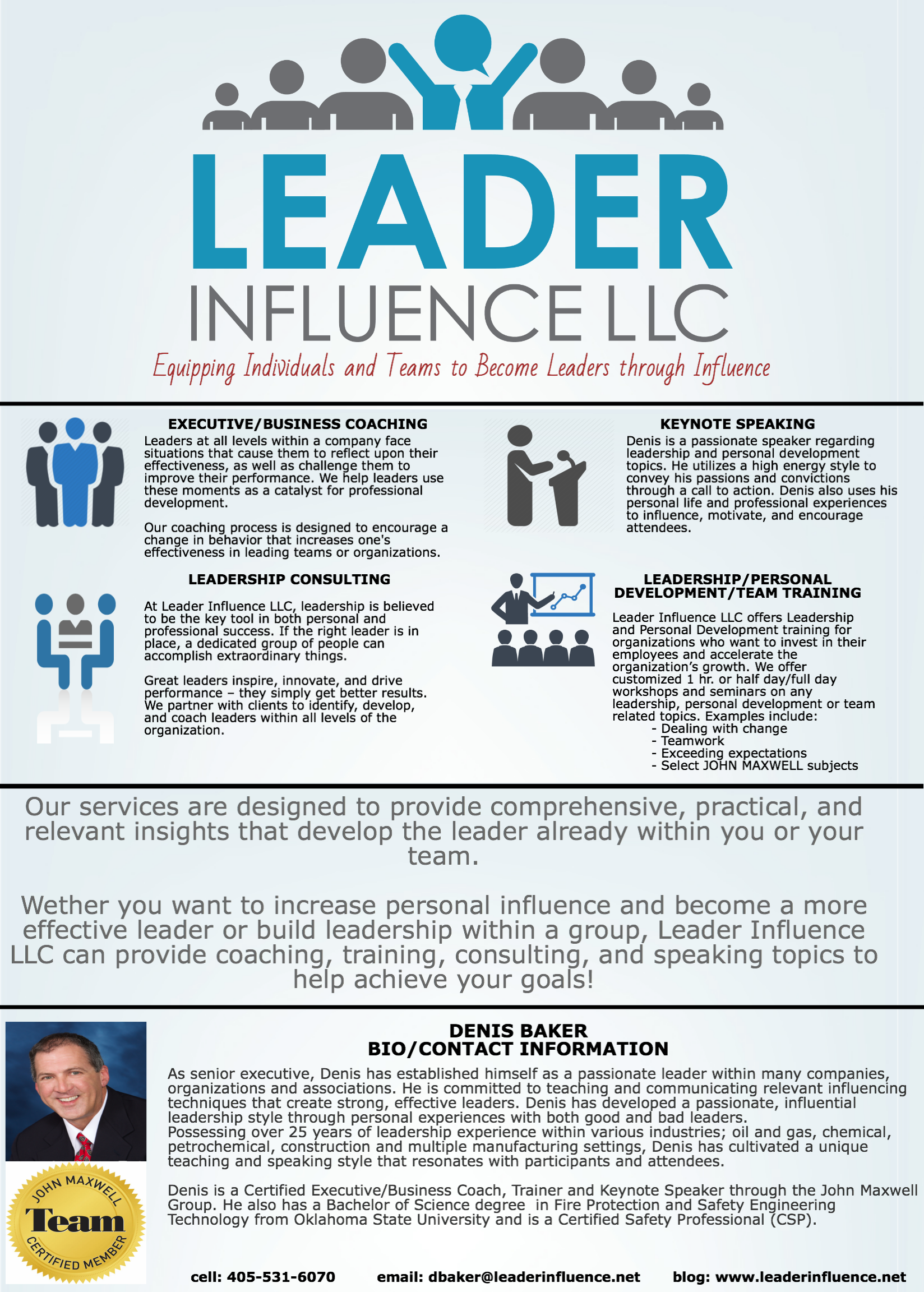
Leader Influence.net is also Leader Influence LLC.  If you find the information presented on this blog helpful or intriguing, then Leader Influence LLC can take you further.  The attached brochure explains our services and our desires to INFLUENCE individuals and Teams.  Consider Leader Influence LLC next time you are looking for a trainer, speaker or coach.


leader-influence-2-2