HOW TO KEEP A POSITIVE ATTITUDE IN AN UNCERTAIN ENVIRONMENT

What a week!  This has been one of unexpected personnel change.  Being a senior leader in the oil and gas services industry, I’ve learned to be flexible.  The current market has created a daily sense of the unknown.  It seems every day I’m walking through a jungle.  Mired deep into the unknown.  Everyday seems to be an adventure to maintain a positive attitude. Sleepless nights are normal.  If five hours of good REM sleep is achieved, I am satisfied and elated.  Worry and anxiety become a normal routine. Our attitudes can take a big hit in an uncertain environment.

However, it doesn’t have to be that way, because we have control over our thoughts and attitude.

ATTITUDEFotosearch_k23073832

Attitude is dependent on your feelings toward something, someone or a situation.  Each person has an inward voice that encourages either self-promotion or self-defeat. Yes, there are some things that happen beyond our control. We all experience disappointment, heartache and difficult situations. However, what we do have control over is our response. Someone once said, “it’s not a matter of what’s happened to you, but rather how you respond to what’s happened.” It’s important to note here, there is a distinct difference between a response and a reaction. A reaction is “a feeling experienced in response to a situation or event.” Reactions are often quick, emotion filled responses. A response, on the other hand, involves more reason. It is a thoughtful, more appropriate answer to a certain situation.  Worry and anxiety will create the negative attitude and the inability to properly view the situation.  It creates a cloudy view.  In doing so, we are unable to properly asses the situation and take the necessary steps to correct it.

WHAT TO DO

So how does one keep a positive attitude and maintain their sanity in an uncertain environment?  I think the answer is easy, but the reality is hard.  As a person of faith, I personally look for my strength through my Lord, Jesus Christ.

However, I supplement my faith through these six (7) practical principles;

Insomnia

  1. STOP, What just happened? I get an email.  There have been personnel changes.  Your phone rings, informing you of something negative. Things are going downhill fast. You’re in a tail spin, making reactive decisions that, unfortunately, compound the problem.  Things are said, actions are taken and regret begins to set in.  What do you do?  Take some time to just step back from the problem and think. This will enable you to rationally deal with the issue at hand, instead of emotionally reacting. Just remember, you don’t have to do anything.
  2. When things go in a direction I didn’t expect, I turn to prayer.  Prayer creates a mindset of humbleness.  Worry and anxiety are turned over to him. I am reminded the circumstances are out my control, why worry and be concerned?
  3. Stick with your goal. Regardless of the situation, stick with your goal and what you know. When trouble hits, it tends to steer our focus off from where it should be. When a pilot encounters trouble, they immediately move into a systematic process to try and solve the problem.  However, they are focused on the goal of landing the plane safely. If they lost sight of their goal, disaster would certainly be imminent. One of the best things to do is to write out your goal(s).  Write out what steps are needed to achieving them.
  4. Analyze and Identify a solution. Sticking with the example above. The pilot will analyze the problems and determine the best solutions.  He/she is not sitting idly by, but rather analyzing the problem and aggressively identifying solutions and next steps.
  5. Surround yourself with encouragement. We all need encouragement.  Especially in a time when situations don’t go our way.  I’ve learned if I continue to dwell on the negative, worry will begin to take over creating a slippery slope downward.  My attitude changes and I have a negative affect on all.  When our backs are against the wall, we must surround ourselves with those who love and care for us and who will encourage our next move.  I look to the scriptures for my encouragement and seek out the wisdom of those I trust.  The book of Psalms has always been a source of encouragement.
  6. Find the good. Count your blessings.  I have a new grand daughter.  My wife and I are a month from our 30th wedding Anniversary.  Things are great.  However, the negative began to creep in.  Was I next? What would we do?  My thoughts began to run wild.  I enjoy my job and my life.  How would it be without it? My thoughts controlled my analysis  I began to panic somewhat.  I immediately stopped myself and focused on the good things.  I have been here before. In 2008, I lost my job.  I was weeks from loosing my house.  I made it through that.  Spend time dwelling on the good things about your life or career instead of the problems. There is an old childhood song that says, “Count your blessings—name them one by one.” That’s great advice! Let your positive attitude develop from within as well as from without. This makes all the difference!
  7. This isn’t forever.“This too shall pass” is a common saying I typically hear from people in difficult situations.   Remember that difficult times are only a season.  Some are longer than others, however it is a season.  We all go through them.  Teddy Roosevelt said, “Do what you can, with what you have, where you are.”  There will be a future where circumstances will change and you will be on top of the mountain instead of down in the valley.

First Sun Light over Mountain Valley - Panorama.  Smoky Mountains National Park, Tennessee

I hope none of you will ever go through anything negative or experience uncertain times.  Unfortunately the reality is you will.  We live in uncertain times.  It is becoming the norm.  There will always be upheaval in life. This will create worry and anxiety and have a negative affect on our attitudes. However, how we handle these times and our reactions will determine the outcome with others. A good attitude in difficult times will encourage others.

Remember to STOP, PRAY, STICK , REFLECT, ANALYZE and IDENTIFY SOLUTIONS, SURROUND AND REMEMBER, THIS ISN’T FOREVER!
LEADER INFLUENCE LLC

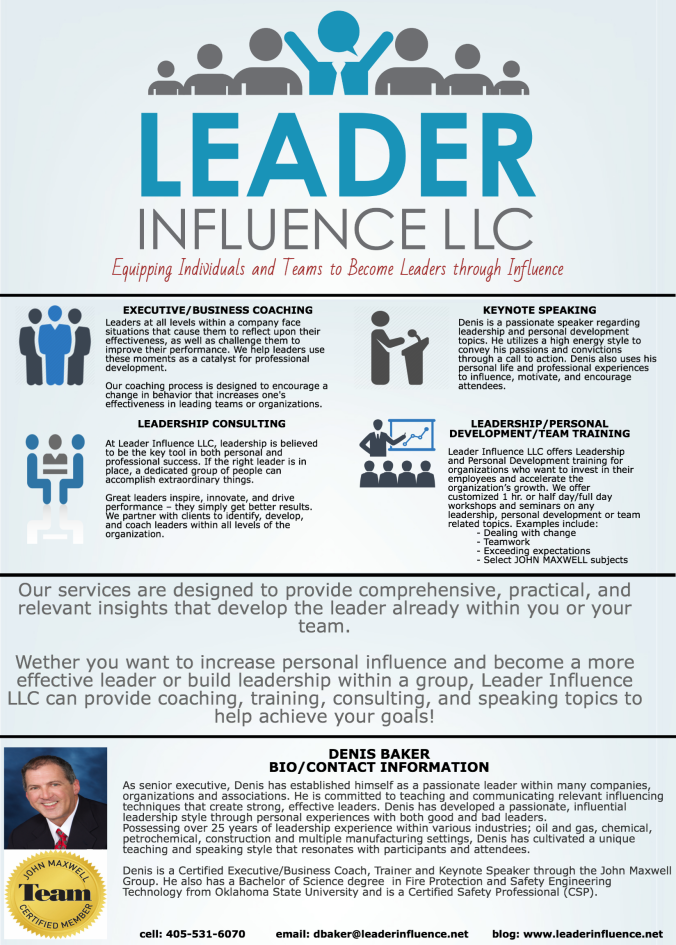
Leader Influence.net is also Leader Influence LLC.  If you find the information presented on this blog helpful or intriguing, then Leader Influence LLC can take you further.  The attached brochure explains our services and our desires to INFLUENCE individuals and Teams.  Consider Leader Influence LLC next time you are looking for a trainer, speaker or coach.


leader-influence-2-2

AVOID SENDING THE WRONG MESSAGE, Email and Texting Etiquette for Leaders

Fotosearch_k5844859You’ve been there.  You get an email from a colleague that is accusatory or is downright rude and inappropriate.  The email is addressed to several people.  As you read the email, the words and letters begin to form sentences that spark enraged furry from deep down in your gut.  Your ears turn red and your blood pressure spikes.  How dare that so and so….!!!  You react with self-preservation and vigilance by hitting “Reply All”.  In fact, you decide your boss needs to see this, so you “Bcc” him/her.  Through your fit of rage, you unleash a barrage of words that belittle and berate the original sender.  You do it with a grimace and smirk along with the self-gratification the you will defend yourself and your position to the END and that NO ONE will ever question you again!!!  YOU WON!!!

Immediately, after hitting the send button, you receive a text from your boss.  Yes!  He wants to congratulate you on a great response!  Only when you open the text, it says “meet me in my office first thing in the morning.”  Well, you get the picture.

Is this the behavior and response you would expect from a leader?  I would hope not.  However, I see these types of emails and responses every single day.  And yes, I’ve been guilty of some of the harshest.

Email and texting are two of the greatest forms of communication since the invention of the telephone. They have increased productivity by huge percentages.  People are now connected 24/7.  We can email and text our thoughts and ideas anytime, anywhere.  However, email and texting have also been the worst inventions since the telephone.  Now people can email and text their thoughts and ideas anytime, anywhere.  Most of the time this is without any thought or discernment.  Email and texting have taken the place of face-to-face communication or a phone call.  It’s become the easy way out.  Well, that creates problems when connecting and building relationships.

Leaders must understand the role communication and relationships play in leadership.  In order to ultimately influence people and eventually lead them, we must ensure we continue to connect and build sincere relationships.  Emails and texting, perceived in the wrong way, can disconnect people and ruin relationships.

“Email and texting should never be a substitute for face to face communication or even a phone conversation.”

However, if crafted correctly, these tools can be very effective in re-inforcing your ideas, thoughts or desires.

Here are some rules and etiquette for using email and text.  These rules have become very useful and effective and tend to lessen the chance of responding in a destructive or unprofessional manner.

EMAIL

Fotosearch_k7573769When preparing or crafting an email consider the following thirteen (13) suggestions:

  1. First consider a face-to-face meeting or phone conversation before sending an email.  Especially if the subject and content is sensitive or could be wrongly interrupted.
  2. Send the email only to those that absolutely need to know the information.
  3. Only those addressed in the  “TO” field are required/expected to respond.
  4. Anyone addressed in the “CC” field are being included for “information only.”  “CC” those that may help reinforce your message or need.
  5. Those addressed in the “CC” field should not respond unless they have a compelling reason to reinforce the message or if they have additional information considered valuable to the group.
  6. Make sure the “subject” is an accurate depiction of content.  It should include any dates for deadlines, etc.
  7. Content must be specifically related to your “TO” group. Be specific and clearly communicate your desires, wants or actions.
  8. Always begin an email with a positive statement. The first 5-7 seconds of your email can determine the outcome.
  9. There should NEVER be more than two emails discussing the same subject. 
  10. If there is continued disagreement or confusion, you should set up an in person meeting, conference call or video chat.
  11. READ IT BEFORE YOU HIT SEND AND THEN READ IT AGAIN. Read and re-read your email.  Make sure your grammar, spelling and choice of words portrays the intended tone and message.
  12. Emails should NEVER be used to reprimand, counsel or address disagreements. 
  13. When in doubt…….have a face-to-face conversation.

When replying to emails, consider these ten (10) suggestions:

  1. Read and reflect on the email content prior to replying. Your leadership effectiveness is reflected in your response.
  2. Don’t automatically hit “Reply All”.  This should only be used when needed, and with extreme caution.  You should only use “Reply All” when everyone on the “TO” list requires your response.  Most of the time, it is sufficient to only reply to the person who sent the email.
  3. Be Careful with the “Bcc”. The “Bcc:” option allows you to “blind carbon copy” someone on an email without any of the other recipients knowing. It’s useful in certain instances, such as when sending a message where you wish to keep email addresses private, or when you are requesting information from a group and want to get the responses. However, “Bcc’ing” can also backfire! The best “Bcc” rule of thumb: Never use it for sneaky or “I gotcha” reasons!
  4. Avoid Cursing. Cursing in an email is wrong, ALL the time and EVERY time!!!  End of story.  Don’t do it.  What if the email is forwarded? It can also be used as grounds for harassment and a hostile work environment.   What you write is there forever.  I don’t care what Hillary Clinton and the White House say.  Cursing in an email comes off as being ignorant or showing a lacking intelligence.
  5. Use proper grammar.  Don’t write like you speak, but instead like a professional.  Remember, emails are forwarded all the time.  A poorly written email going to the boss or the board can halt a career very quickly.
  6. Respond Regardless. Everyone deserves a response, even if the email was mistakenly sent to you.  A simple, “I got your email”, or “I think this was sent to me by mistake” will let the sender know they are on your radar.  Be smart and respond to those emails that suggest action, etc. Information only emails don’t necessarily require a response.
  7. Be leery of tone. Each person interprets email tone differently.  A well written email can easily be interpreted as a negative with the use of various words.  In addition, many people use all caps.  When you do this, it usually implies YOUR YELLING AT SOMEONE.  Unless that is your intention (which it shouldn’t), use *asterisks* around the word or words you want to highlight.
  8. No cuteness. There is no room in a professional email for cuteness or emotional acronyms.  No smiley faces, pink dogs, LOL, BTW
  9. Include a professional signature. Include a signature.  Your signature should include; your full name, title, work address and phone number.  When using a quote or image, be careful that it does not offend.  Keep everything professional and business appropriate.
  10. READ IT BEFORE YOU HIT SEND AND READ IT AGAIN. Read and re-read your email. Make sure your grammar, spelling and choice of words portray the intended tone and message.

TEXTING

Texting is easy.  In fact, I think it has become the preferred method of communication.  Co-workers are texting each other as they sit cubicle to cubicle.  Parents are texting children in the next room and, in some cases, from the dinner table to the media room.  Texting has become a connivence, it is faster, simpler and easier.  Even though the “phone” is a voice communication device, texting has become the preferred mode when using it.  It is the lazy way to communicate.

Texting is also gaining acceptance as a formal method of business communication. However, when you are texting for business, it is “imperative you always abide by a specific set of professional etiquette rules”, says career coach Barbara Pachter in her book “The Essentials Of Business Etiquette.”

Here are seven (7) texting principles I found to be very helpful:Fotosearch_k26085789

  1. Be careful with abbreviations. Texting is meant to be a fast form of communication, so we tend to use abbreviations and shortcuts such as “np” (no problem) or “u” (you). But there is such a thing as an inappropriate abbreviation. Use only shortcuts that are widely known or recognized. Ultimately, the safest route is to type out the entire word or phrase.
  2. Be aware of your tone. Texting is a fast and easy way to communicate.  Make sure you use words that set your intended, not perceived tone.  Avoid negative words such as failure, wrong or neglected.  Instead, use please and thank you.
  3. Never send bad news via text.  I had an employee resign via text.  I was shocked.  Needless to say, that bridge was burned.  Keep texting positive.
  4. Don’t change meeting times or venues in a text. Not all people live with their phones in their hands waiting for the ding or vibration.  If you change something and communicate via text, you may need to start without your party.  HOWEVER, you can confirm meeting times or venues through text.  Great way to get a headcount or confirm where you need to be.  Just do it early to give the recipient time to respond.
  5. Always double check when using the voice-to-text feature.  Smartphones allow you to speak your message, which the phone then converts to text.  But a lot can be lost in the translation. Make sure you what is showing as text, before you hit the send button.
  6. Don’t text during a meeting or presentation. This is just rude!  Even if you are doing it under the table or behind a book, the presenter can tell.  As a speaker and trainer, it offended me when I see people looking at their phones.
  7. Darn autocorrect!  This bites me often. Watch the auto correct feature.  A great way to beat this problem is to READ your text before you hit send.

By following these simple rules and abiding by proper etiquette, mastering the ability to craft and send effective emails and text can be easy.   I crafted this blog, not only because of my shortcomings, but due to the many frustrations I often feel when I see these not used.  As a student and teacher of leadership, I want to make sure I do everything possible to influence as many people as I can.  I realize how we respond to emails and text can result in positive or negative consequences.  I want to do everything in my power to keep it positive; I hope you will too.


LEARN TO BE MORE GRATEFUL, A lesson from Jim Rohn

“Learn to be thankful for what you already have, while you pursue all that you want.”, Jim Rohn

I don’t typically re-post articles.  However, on occasion, when I read something and it helps or moves me, I believe I must share with others.

Over the past few months, I have been feeling very thankful for my life, wife and family. The last few months has been trying to say the least.  The industry I am in, has suffered a great loss of jobs, my daughter has had a challenging pregnancy (my first grandchild) and my mother had triple by-pass surgery.  However, through all the various trials and tribulations, I have seen a work in each affected life including myself.  A change in people, persons and families, in relationships and finances and in circumstances and situations.  I have been grateful to watch how God nudges his will into each situation and how each person has grown in and through it.

Don’t take life circumstances for granted.  But rather, learn to be grateful for everything.  I hope the following article will help you become more grateful in your life. It did me.

Fotosearch_k21901989.jpg

 “5 Ways to Be More Grateful Everyday.”, Jim Rhone

I believe one of the greatest lessons we can learn is to be thankful and grateful for what we already have. But gratitude is something we have to work at—to prepare our hearts to be reflective and thankful, to provide room for contemplation of our good fortune.

Here are some words, some thoughts that are simple and practical to apply, that you can use right away in your quest for becoming more grateful:

1. Time – Set aside time regularly to be quiet, to reflect. We live in the fastest paced time. From the moment we awake to the moment we collapse into bed, we have the opportunity to go at full speed and never slow down. If we schedule time every day in which we can be quiet and reflect, we will free our hearts and minds up from the tyranny of the urgent and rushed.

2. Thought – Give thought to the many blessings that you have. Living in a consumer culture, most of us are fully aware of what we do not have—and how we absolutely must have “it.” But how often do we reflect upon that which we already have? Take some time each day and think of one or two things that you have that you may typically take for granted, and then take a moment and give thanks for those things. Make this part of your reflection time.

3. Generosity – Be generous toward those with less and not envious of those with more. We tend to look at others who may be wealthier than ourselves and think, I sure wish I had what he does. That kind of thinking breeds envy and jealousy rather than contentment. What can we do to break that cycle? I would suggest being generous to those who are less fortunate than yourself. Go to work at a food bank. And not just during the holidays, but on a regular basis during the year. That will remind you of how good you really have it.

4. Ask – Ask a friend what they are thankful for. You will be amazed at the answers you receive, and you will create meaningful bonds as you focus on this powerful question.

5. Acknowledge – Lastly, tell those you love how thankful you are for having them in your life. So many times we neglect to take the time to craft the words to express to those closest to us what their presence in our lives means to us. Take the opportunity to write them a note. Let them know what they mean to you, and in return you’ll begin to create the possibility of deeper, richer, more fulfilling relationships with those you love.

EXCEED YOUR INDIVIDUAL GROWTH WITH A MENTOR

Fotosearch_k7980430.jpg

The longer I continue in leadership positions, the more I realize how much I really don’t know. In fact, I’m made aware of this each and everyday. I’ve learned; the more I think I know, the more I don’t know and the more I don’t know, the more I need to know! However, one thing I do know, knowledge needs to be transferred to others.

Everything you learn and receive from others is not yours; you are simply a processor of information and it must be passed on. Whether it’s a recent graduate, a technical person, or an experienced professional, I realize that my job as a leader is to transfer knowledge and experience to them. That’s what drives me.

I rFotosearch_k13876036.jpgeflect upon my parents, youth leaders, pastors, coaches, and career professionals who imparted wisdom, knowledge, and experience to me. Without them, I wouldn’t have known how to navigate through life’s challenges. Mentors have been influential in life, impacting both my marriage and my career. In fact, I can recall an individual whom I still lean upon for guidance in my safety career. He has directed, advised, and even scolded me when needed (unfortunately that’s often). Additionally, he has pointed out when I’ve had ideas of significance or times when my attitude needs an adjustment. Everywhere I turn and in almost every conversation, there seems to be an opportunity to either mentor someone or to be mentored myself. I came across this statement the other day; It’s hard to improve when you have no one to follow but yourself.” To me, this quote reiterates the belief that influence develops through experiences with others.

Identifying the right person to advise you is equally important to what you learn. So, how do you identify and chose a mentor? Below are 10 questions to ask before considering a personal mentor in your own life.

  1. Are they a leader? – John Maxwell concludes, “It takes a leader to know one, show one and grow”If they haven’t experienced it, done it, or taught it, I question whether they are ready to mentor. Identify those who are successful in their professional or personal endeavors. Look for someone who is respected and viewed by others as a leader. When identifying a mentor, seek someone whom you regard highly. You don’t have to aim too though; if you’re pursuing politics…do you need the President of the United States as you mentor?
  1. Are they open and available? – A mentor must be willing and open to share their experiences (the good and the bad) as well as personal insight. After all, mentorship is a transfer of knowledge. Will they be available to meet on a regular basis? Mentorship is best accomplished through face-to-face interactions.
  1. Can I trust them? – Is the person trustworthy? Do they possess integrity, ethics and the same moral compass you desire? Do they have wisdom to make sound decisions and solve problems? It’s through knowledge and experience of seasoned mentors that problems and situations can be resolved in a correct manner. A wise mentor can guide you through a situation with only a few words; this in turn allows growth through your own experience.
  1. Are they transparent, egocentric, or arrogant? – It’s important to note that even mentors make mistakes; however, does that person readily admit his or her shortcomings to you? When identifying mentors, seek those who are willing to share their experiences, even if some are unpleasant.
  1. Do you “buy into” what this person is about?  – Plain and simple, do they influence you in the right way? In other words, you must be of the same mind before allowing your mentor to influence. I know many successful professionals, but for one reason or another, I simply cannot consent to what they say or how things are done. Maybe it’s in the way they treat others or how tasks are accomplished. Don’t chose a mentor based solely upon their accolades, examine the person as a whole.
  1. Do they honor their commitments, have the respect of others, and consistently model excellence? – A mentor must honor their commitments. If they continually cancel appointments or never answer their phone (via voicemails, emails, texts, etc.), then they are not the right fit for you. Search for those whom others respect and speak highly of. In my own experience, I’ve found that if a person honors commitments and is respected by others, then they often model excellence within their own lives.
  1. Are they relationship builders? – Mentorship is a relationship. A mentor must convey the sense that they care about you and your future. If not, then why are they investing? Is it for self gain? I am not speaking of mere friendship, but rather about connection and a relationship where the individual is committed to helping you reach your potential. If there is no relationship, you will feel frustrated and fall short of expectations.
  1. Do they recognize mentorship as a long-term process? – Mentoring someone requires time and effort, as well as consistency. When evaluating potential mentors, ask questions to ensure their long-term commitment. 
  1. Do they raise good questions?  A good mentor will actively listen to you and assess where you stand. They must be creative in asking open-ended questions, further accelerating conversation. Remember, answers satisfy people’s understanding, but questions deepen them.Fotosearch_k1010396.jpg
  1. Are they willing to have those hard, uncomfortable conversations? – A good mentor will hold you accountable for your actions and failures. You need someone who is willing to expose the truth, rather than guard your delicate feelings. Expectations can be attained if you are held accountable.

The right mentor can accelerate your personal and professional development; the wrong mentor can destroy it. Nevertheless, if you are detailed, prudent and purposeful in your evaluation of potential mentors, you can ensure advancement, growth, and success in your life. Someone once said, “you pay for consultants, not mentors” and I believe that this statement is spot-on. If you “purchased” a mentor, then they wouldn’t be truly committed to you. Likewise, you can’t earn a mentor but rather, you earn a mentor’s attention.

Therefore, work hard in all due diligence to identify a mentor in you own life. I hope these 10 questions will serve as a guide on your endeavor and that you will recognize the importance a mentor has upon personal growth. I’ve heard some say, The teacher appears when the student is ready,” but I say the following is true; “The student appears when the teacher is ready.”


GRACE ABOUNDS FOR THE STUPID

On February 23rd (which is today as I write this blog), my wife and I should be enjoying a very nice dinner at an all-inclusive resort in the fabulous Mexican Riviera Maya.We were to celebrate our 30th Wedding Anniversary. This was to be a time where we would reflect on the last 30 years, both the good and the bad. Our marriage hasn’t always been easy, but it hasn’t always been hard either. Through the grace of God and hard work from each of us, we have taken challenging situations and turned it into a wonderful union. Regardless, 30 years is cause for celebration!th-50

White sands, blue water, 80-degree temperatures and a high UV-Index…SHHHHHH, I can feel the sun on my face and hear the waves crashing. Well, that’s what we should be experiencing…but something horrible happened!


 MY passport did not have 6 months validity past the day of return. 

I looked at my passport several times throughout the last few months and I never snapped to it. Marlene (my wife) and I got my passport out of the safe a couple of weeks ago and thought we were good to go. We ASSUMED everything was good. Here’s the thing, my passport doesn’t expire until March 16th and we were to return on March 2nd. What’s the problem? As a last minute precaution, I decided to ensure that I didn’t need any other documentation before traveling. It was then that I noticed the requirement for a 6-month validity. Marlene began a frantic search for the truth and much to our dismay, we found it to be true!

I began to research options. One, I could expedite my renewal and go to the Regional Passport Center and spend the day in hopes of receiving my passport in time for travel. Or two, we could cancel the whole trip and get back a portion of the money already spent. The predicament was this; the deadline for the resort cancellation was the 19th (the same day we found out about the passport issue). FullSizeRenderSo, if we did not cancel that day, we would lose the full payment, but if we cancelled by 6 pm on the 19th, we would only lose a 2-night penalty. After much discussion, research and prayer, we decided to cancel. This was very difficult and disappointing decision. Imagine being in Oklahoma and only days from spending 8 nights on the beach in Mexico! Come on, anyone would be saddened!

To make the best of the situation, Marlene and I identified some things we learned from the experience. After all, if you’re going to mess up, you should at least learn something.

We did learn some things.  Here they are:

FROM MARLENE

The following points are directly from Marlene-

  • YOU NEVER “ARRIVE” -I thought I was beyond making this kind of mistake. The truth is, we are all susceptible to making careless errors.
  • THERE ARE ALWAYS 3 FINGERS POINTING BACK AT YOU – Don’t be quick to look down on others if they don’t have what you consider to be your strong points. Again, just because I pride myself on being organized and on top of things, doesn’t mean some things don’t occasionally slip or “fall through the cracks.”
  • I’M DISAPPOINTED! – There are times of disappointment. Be sad, but then put it into perspective. It’s a disappointment, not a tragedy.

When I came home, it was apparent that Marlene was disappointed and I could see she was dejected. Allow me however, to brag on her a bit. Even though it was a disappointing situation, she was not upset or hateful towards me. In fact, she was the complete opposite and tried to take responsibility herself. She felt liable in planning and working out the details of the trip. Although I truly believe I was responsible, her humility was appreciated.

FROM ME

Here is what I learned:

  • PAY ATTENTION TO DETAIL – You must pay attention to detail. Although I glanced at the passport several times, it never occurred to me to check the expiration date.
  • TAKE RESPONSIBILITY – One of the worst things you can do when you make a mistake is point a finger at someone else. Not only does this make you look like you’re skirting around responsibility, but also deflecting ownership will put someone else undeservedly in the “hot seat.” As soon as an error is brought to your attention, accept responsibility in the situation (despite whether or not it could have been avoided). Examine the issue and rectify the situation.
  • AVOID MAKING EXCUSES – Everyone has an excuse for things they’ve done wrong. Excuses don’t eradicate the fact that you made the mistake to begin with. Making an excuse isn’t any different than assigning the blame to someone or something else.
  • FIX IT -Once you realize you’ve made a mistake and acknowledged it, take steps to fix it. My mistake wasn’t anyone else’s responsibility, but my own.  I researched options to rectify the situation, but due to time constraints and the possibility of losing all our money, we chose to cancel the reservation altogether.
  • LEARN FROM IT – It you don’t learn from your mistakes, you wasted a valuable and sometimes expensive opportunity. Marlene and I took a lot of time discussing what each of us could do to prevent a similar situation from happening in the future.  We are in the process of renewing my passport and she has noted her own passport’s expiration date. In response, she has created a calendar notice to make sure her expiration date doesn’t slip past us unknowingly. Remember, every mistake is a valuable opportunity for self-improvement. Embrace the lesson learned and move forward.
  • MOVE ON – It’s okay to be sad and disappointed. However, don’t dwell or hold grudges. YESTERDAY ENDED LAST NIGHT! The mistake has been made, acknowledged, fixed and learned from. Realize that mistakes are inevitable and underneath it all, they can be truly beneficial.

I think the biggest lesson learned from this fiasco was that while we were let down, this situation ultimately brought us closer together and made us both realize how easily errors are made. The way we respond and handle stressful situations determines the outcome.

Although we dream about being on the sand, enjoying the sights and sounds of the ocean, great food and the overall culture of Mexico, we have sincerely moved on and feel at peace from what we’ve learned.

IMG_3367I love the couple that Marlene and I have become. There was a time in our early marriage where something like his would have involved blame and lasting grudges. However, with the leading of our Savior and the commitment we have made to one another, we were able to acknowledge our mistake and move on with a stronger marital bond.
WHAT A DAY! Tough Days Create Better Leaders

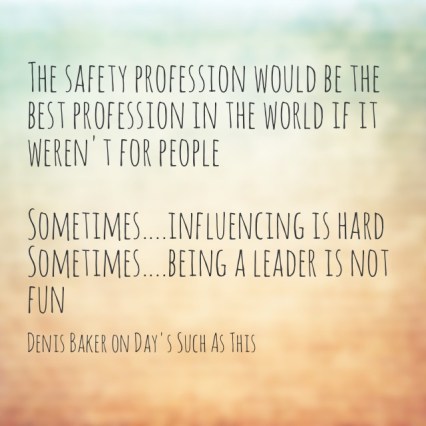
I recently posted the following meme referencing a challenging day.  IMG_0016The reference to people and profession is applicable in most vocations, especially if your line of work includes interactions with others. Essentially, all professions involve people in one way or another.

I remember a book I read to my daughter many times throughout her childhood, a book titled Alexander and the Terrible, Horrible, No Good, Very Bad Day written by Judith Viorst. Allow me share a quick overview of the story. From the moment Alexander awakens, things just don’t go his way. As he wakes up, he finds the chewing gum that was in his mouth the night before, winds up in his hair. When he gets out of bed, he trips on his skateboard and drops his sweater into the sink while the water was running. At breakfast, his brothers, Anthony and Nick, reach into their cereal boxes and find amazing prizes, while he ends up with just cereal. In the car on the way to school, he doesn’t get a window seat. His teacher, Mrs. Dickens, doesn’t like his picture of alexander-terrible-day-coverthe invisible castle (which is actually just a blank sheet of paper). He’s criticized for singing too loud and leaving out the number 16 at counting time. His friend Paul deserts him for his third best friend and there is no dessert in his lunch bag. The dentist tells him he has a cavity (Amongst his siblings, he is the only one). The elevator door closes on his foot, Anthony pushes him into a mud puddle, Nick calls him a crybaby and he punches Nick in response. Alexander is punished for being muddy and for trying to punch Nick. At the shoe store, they’re out of Alexander’s choice of sneakers (blue ones with red stripes), so his mother has to buy him plain white ones. At his father’s office, he makes a mess of things (the copy machine, books, and telephone) while playing around. His father exclaims not to pick him up anymore. At home, they have lima beans for dinner (which he hates), there’s kissing on TV (which he also hates). Bath time becomes a nightmare, the water’s too hot, soap in the eyes, and his marble goes down the drain. To top it all off, he has to wear his railroad train pajamas (he hates those)!  At bedtime, his nightlight burns out, he bites his tongue, Nick takes back a pillow he said he could keep, and the cat chooses to sleep with Anthony. One repeating phrase throughout the book is Alexander’s claim to move to Australia (surely life is better there). The book concludes with his mother’s assurance that everybody has bad days, even those who live in Australia!
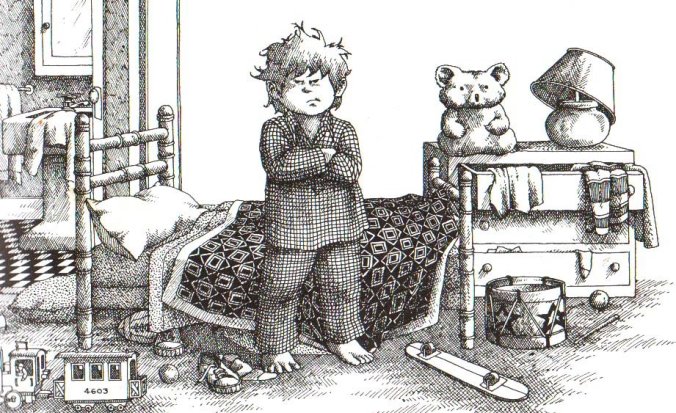
terrible-dayWell, maybe your bad days don’t include gum in your hair or kissing on TV. Whatever it is that creates a bad day in your book doesn’t matter; what does matter, is the fact that you had a bad day. How we react and respond to bad days exposes our leadership maturity and our ability to continue to effectively influence others.
In reference to the meme I previously posted, my bad day was filled with numerous calls involving various groups and individuals. It included repeating the same information multiple times to multiple groups of people. The topic was simple…is the work area safe? If not, then don’t do it! This sounds simple, but apparently not. Come on people…it’s not that hard! Needless to say, my patience waned and it was one of those days that I was ready to end!

As you probably know, I study leadership diligently. I am a certified coach, trainer and speaker for the John Maxwell Group. I teach and speak about leadership daily. I assist professionals through the coaching process to become better leaders. With all of these leadership activities, I shouldn’t struggle with leadership issues right? No, not really. In fact, I think I struggle more because I know when I’m wrong and what I should do. Sometimes my strong-willed personality prevails (I’ve found, however, that it’s not always a bad thing). Most of my personal leadership growth and training comes from daily interactions with people and real world situations; hence the reason why I try to provide practical and relevant insights in becoming a better leader. I won’t waste an opportunity right now to do the same; listed below are 11 nuggets of wisdom that I’ve learned from my recent experience.

  1. YOUR REACTION IS YOUR RESPONSIBILITY – The way you react to the situation causing your bad day is 100% your responsibility. Slow down and think before you react.
  2. EVERYTHING IS AN OPPORTUNITY – Everything that happens is an opportunity for personal development. Don’t miss out!
  3. YOU MUST ALWAYS LOOK FOR WAYS TO INFLUENCE – Take this opportunity to influence those involved. Remember, adding value will allow you to influence and influence will produce leadership.
  4. YOUR ATTITUDE IS CONTAGIOUS – Your attitude in difficult times has a direct effect on others. Never forget, attitude is contagious.
  5. DISTANCE YOURSELF FROM WHATEVER IS CREATING YOUR BAD DAY – Whatever caused difficulties, look for ways to disconnect or remove yourself from the situation.
  6. ACCEPT THE CHALLENGE – Remember that everything is an opportunity. Identify the cause and look for ways to correct, eliminate, or make better.
  7. DON’T OVER-ANALYZE THE DAY – It’s just a bad day. Reflect and make adjustments. Remember…yesterday ended last night!
  8. LEARN A LESSON –Without over-analyzing, look for the lesson in the situation.
  9. DON’T ALLOW ONE BAD DAY TO CAUSE ANOTHER – Come on, it was one day in your life. Don’t carry grudges against people or situations.
  10. IF BAD DAYS BECOME CHRONIC, RE-EVLAUATE – If you continue to have bad or difficult days, then maybe you need to re-evlauate your approach, work habits, etc.
  11. NEVER LOSE SIGHT OF THE BIG PICTURE – Regardless of what happens, remember you have a purpose. Make adjustments when necessary, but stay the course and strive to exceed expectations.

There you have it, those are some of the things I learned or identified as a result of my recent bad day. I refer to them often and adjust them to fit my particular situation. I encourage you to do the same. Just remember, everyone has a bad day…EVEN IN AUSTRALIA!


You Told Them!

A very short blog to help you not make the same mistakes I did!

I learned a very valuable lesson recently. In an attempt to ease anxiety and comfort someone, I shared something that I had knowledge of I thought would help to relieve the anxiety and stress that a colleague was experiencing. Unfortunately, that information did not stay where it should. Instead it was used as a source of control, power and position, eventually getting back to the person that originally trusted me with the information. This put them in a very difficult position. 

Needless to say, I was informed by a text that simply said, “you told him?”

Wow, shock, awe and anger all welled up inside of me. I wanted to run and hide and ignore what I just read.  My gut was in knocks. I had just betrayed someone that trusted my with information. Information a senior leader in the company should have kept private. I didn’t. I used it to show my position and my arrogance of knowledge and information.   What a dummy!!!

However, I learned a lot from this;

  • You should not say anything to anyone that you wouldn’t say to them. Will it pass the red face test?
  • People will use information in order to gain influence and credibility for themselves. 
  • You must quickly iniate a dialogue with the person whose trust you betrayed. 
  • Show true humility in acknowledging your wrong doing. And sincerely apologize with immunizing the situation. 
  • Recognize your need to rebuild that trust. 
  • Immediately forgive the person that betrayed your trust. It is not their fault. You are the one who told them something you weren’t suppose to.  
  • Realize NOTHING is sacred from ANYONE at ANYTIME. If people can use the information for gain in position or influence, they will take the risk of betrayal. 
  • Work should be work and you should always understand the information you get at work is part of your job. Telling any confidential information to others is a job performance issue. 

I have personally learned this through my own stupidity and lack of good judgment. 

Even when you are trying to put someone at ease and share information, you must understand the risk level and the need for confidentiality. 

Leaders must remember we are leaders all the time, every time through every situation. We must always calculate our next move, check our hearts and motives and always do the right thing. 

Chuck Swindoll said, “If you want to be miserable, live only unto yourself. Think only about your own needs and desires.”  I believe we need to always check out heart and determine our motivation and desires. 

It’s not about you!!!!!!!
 

REALLY, YOU LEAD PEOPLE?

Fotosearch_k15793683

I read an article the other day that touched on leadership behavior.  It sparked an abundance of memories, thoughts and questions that have rolled around in my head for many years.  Quite frankly it made me look deep inside of my soul and check my heart to ensure my actions and motives line up with my moral convictions.

Look, leaders are people.  In fact, many are good people.  There is a very small percentage of leaders that act and behave poorly.  I feel I’ve probably worked for more than most.  My career has been full of poor leaders.  Heck, there are a lot of my past and present employees that might say the same about me.

The whole reason I began my leadership journey was to do everything I could NOT to make the same mistakes or do the same things I have witnessed or gone through.

Through my experience, I have identified 9 things that define poor leaders.  Here they are;

  1. IT’S ALL ABOUT YOUNo it isn’t!  In fact, we probably don’t About.me_iconcare what you did or where you went.  It is about those you lead.  When every conversation and situation is about you, it limits the interaction and contribution of others.  I’ve had many leaders more concerned about how situations affect them, than the one(s) involved or affected.
  2. HEY BUDDY -Considering those you lead as friends.  Not good. Leadership is about relationships, not friendships.  When friends and buddies don’t perform we tend to “sweep” it under the rug or make excuses, rather than hold them accountable.  This creates descension and frustration with other employees.  Build relationships, not friendships.  I’ve seen many leaders lose credibility over the hiring or advancement of friends or relatives many times.  I am not saying you can’t hire employees from the past or those who supported and assisted you at other jobs.  I was the best man at my Director of EHS’ wedding 29 years ago.  However, I bet he will tell you that he is held to the same accountability level as anyone else.  In fact, I expect more out of him, than most.
  3. HORRIBLE LISTENER blah, blah, blah…….  This leader doesn’t care what you have to say.  They are only concerned with what’s coming out of his mouth.  Their EGO gets in the way.  Hey man, you were given 2 ears and 1 mouth for a reason.  You need to listen twice as much as you talk.  Give people a chance to say something.  Who knows, what they have to say might solve the problem.
  4. WHAT ARE YOU THINKING? -Poor communicators can reduce and harm aculture and frustrate employees quickly. Many employees complain about the lack of communication from leadership.  What are my expectations, Fotosearch_k10378786How is the company performing?, Will there be raises or bonuses this year?  As I coach leaders, I encourage them to have weekly or monthly communication meetings.  This is a time where all they do is communicate key information and allow employees an opportunity to ask questions.
  5. DON’T TEXT ME -Technology is great, but technology has created a diminishing environment of face to face communication.  How many times have you received a text or email and interrupted it as negative?  Texting and emails are very difficult to communicate a tone.  A face to face visit is the best way to properly communicate.  I can see your facial expressions and body language and I can react or change my tone or words to ensure effective communication.  If you can’t meet face to face, call them, and don’t leave a voice mail to cover your items.
  6. REALLY?Hear’s a thought……Get both sides of the story before you make a decision.  One of the most frustrating things for employees is when a leader makes decisions based on a one sided conversation.  One of the traits of a leader is to be open and accessible.
    However, that doesn’t mean you base your decisions on the conversations of one individual.  I found many times, my accessibility and openness has allowed individuals to voice their displeasure with a supervisor, rule or practice only to find out in my follow-up conversation the individual was disciplined or held accountable for failure to comply with or follow directions, etc.
  7. THAT WILL NEVER WORKBeing cynical is not a trait of a leader.  In fact, it is totally opposite.  I think cynical leaders feel threatened. They must discount or even put down a person’s ideas because they feel as if they are not a leader if they don’t have Fotosearch_k5253244the answer.  Cynical leaders say; “No, that’s not going to work” or, “I don’t know why we are doing this; this is stupid.”  Look, if something is stupid, then the leader needs to fix it.  If something is not worth doing or is going to create major problems, it’s your responsibility to facilitate other ideas.  Regardless, you must thank and encourage those who offer ideas and opinions, not BELITTLE them!
  8. THAT’S DISGUSTING! Just because you can say it, doesn’t make it right.  Foul language is wrong and unprofessional.   For some reason, leaders feel they have the right to use foul language and tell questionable stories in front of their staff or employees.  I recently had a leader use very disgusting language in reference to a football game. It stunned the group.  No one knew how to react.  I have had several occasions where leaders would use foul language in an email or text.  Regardless of the communication, it is WRONG!  Some have told me, “you have to talk in the language of the industry”. What?  Come on man!!  If that is the case, then we need to clean up the industry!  It doesn’t matter if you are playing, it is your normal language or if you are angry, foul language is wrong, no matter what!  Whether it’s anger, disgust or this is how you talk to your friends, you can’t bring it to the office.
    I can tell if a person has leadership qualities by the way they talk to others.
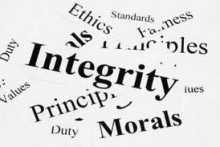
  9. YOU CROSSED THE LINE!Leaders who compromise their integrity for business or profits are FOOLS!   A lack of integrity from leaders doesn’t just annoy employees, it appalls them. In fact, when a leader shows a lack of integrity, employees become de-motivated.  When a boss breaks or fudges the rules, cheats, lies or indulges in behaviors that reveal a lack of moral principles, he loses respect. images7-220x147 respect, you can’t influence.  If you can’t influence, you can’t lead.  In addition, when a leader lacks integrity, he gives employees permission to do the same.  I’ve seen leaders compromise their integrity and moral values to be validated by others.  I have personally seen this take place and the destruction it causes.  A true leader will never comprise their moral integrity for validations.

Being a leader is about doing the right thing and leading by example. You simply cannot have one standard for yourself and one for everyone else. Treat people the way you would want to be treated.

If some of these sound familiar, then do something to correct them immediately.  The longer you continue the easier it is to continue.

WHEN THE EARTH CREATES SHAKY LEGS, A Leader Must Remain on Solid Ground

Fotosearch_k21692991It was 5:39 am.  My wife and  I were laying in bed trying to motivate ourselves to get out and start our day.  As we were laying there, I heard a loud rumbling noise, felt the bed shake violently and heard the windows and pictures shaking.  Things were falling and breaking.  My wife started screaming and I grabbed her and laid on top, protecting her from the falling roof.

We had just experienced a 4.3 magnitude EARTHQUAKE!  This scared the tar out of us!I remember getting out of bed (had no problem getting out now), opening the bedroom door and noticing items on the floor.  Walking around the corner, I saw more and more things that had fallen over or fallen on the floor.  We were lucky, nothing broke and the roof didn’t fall on us.  After calming myself down and holding tight to my shaking wife, I realized everything was ok.  Getting out of bed, I noticed my legs were shaking. My hands were trembling and I had that nervous feeling in my stomach.  A quick look around revealed things had fallen, but nothing had broken.  The house didn’t have any cracks and it appeared all my bricks were still in place on the exterior.

We live in a suburb northeast of Oklahoma City.  If you have watched or read the news in the last few years, you have probably heard that Oklahoma has become one of the most active earthquake zones in the world.  So, we are use to a few jolts here and there.  Most are in the 3 –shake 3.5 magnitude range.  We can feel them and they can be unsettling.  However, I can’t recall anything as jolting as this one.  The ironic thing is I left that morning on a business trip while my wife continued to experience smaller earthquakes and multiple aftershocks.  In fact, she counted 30 that day.  However, even though I had left town, my legs were shaky.  My nerves were somewhat on edge.  As I returned home the next day, I went to bed wondering if I was going to experience another earthquake and how big would it be this time.


Now I know that many have experienced earthquakes much stronger with resulting damage and injuries.  I am not taking anything away from you or those times and I feel for anyone who has experienced it.

Now your probably thinking, exciting, scary stuff, but what does this have to do with leadership?  I’m getting there, just chill.

During this whole ordeal, I realized that people need someone to follow.  Someone who can lead when things are unsettling.  They are looking for direction. They want to follow someone who is in control and can provide a calm meaningful dialogue.  they are looking for people that can provide solutions.

Here are 4 things I realized people look for in a leader when things get a little scary.

  1. REMAIN CALM – I’ve realized others are looking for those they admire to remain calm in all situations, especially when the outcome is unknown or can be life-altering.  Have courage to do what is necessary.  I am not saying there is no fear, but tFotosearch_k27360163
    he fear must not control you.  Fear is contagious.  If someone senses fear in you, they will become fearful. Your family or employees need to believe you are in control, if you exhibit a calm and confident approach approach, they will have confidence you can make smart right decisions.
  2. KEEP EVERYTHING POSITIVE – Everyone is watching you!  Are you calm? How are you reacting to the situation? My wife screamed and cried when the earthquake hit. I reacted by getting on top of her and telling her things were going to be ok. You don’t think I wanted to do the same? What if, I started screaming and panicking?  I think there would have been a lot more screaming.  One thing I have become very aware of is when you become a leader, EVERYONE is watching your actions, behavior, relationships and overall demeanor.  You must maintain a strong positive attitude, smile often and exhibiting a sense of compassion.
  3. COMMUNICATE YOUR THOUGHTS, DESIRES AND INTENTIONS – You must communicate clearly and concisely during an event.  Tell them exactly what you want them to do and then tell them again. Communicating in difficult situations is crucial for both setting the expectations and a successful outcome.  Be sure to use inflection your voice and maintain the volume necessary for everyone to hear.  Be short, quick and expedient in your demands and orders.  I’ve found people react well to calm commanding directions.
  4. REMEMBER YOU’Fotosearch_k21376380VE BEEN HERE BEFORE – Keep your composure, you have been in similar situations before.  Calm and composed leaders that reflect they have been through difficult times before, exude a strong presence with a sense of elegance and grace. This will give you a genuinely compassionate approach to ease the minds and fears anyone may be experiencing.

When things go bad or wrong, and they will, it is the leader that influences the outcome.  Whether it is family, friends or employees, they are watching everything you do, listening to everything you say and looking for direction.  I will admit I was terrified when the earthquake hit.  But I also realized very quickly that I had control of the immediate outcome with my wife.

Sure I had to reflect on what happened and what I did during those few minutes to identify these 4 things above.  However, I
realize there is a leadership lesson in everything that happens.  I have come to the conclusion that I define who a leader is and what a leader does, the more I understand how to use the information and training I’ve gained.

I hope you will take the four items above and learn how to apply them in your life and prepare for the unexpected.  After all………you are a leader!