
Thought for The Day
 I don’t think there is ever an instance where one person is the team, or where one person is responsible for the success or failure of the team. Whether at work or within the family, I believe it always involves a team effort.
As I continue my leadership journey, identifying areas of improvement within myself and when coaching leaders, I am convinced success is always a team effort. Sure, there is always someone who leads the way, but I believe they are supported by the team who is like-minded and supportive of their ideas and efforts.
Experiencing what it really means to add value to a group, I have identified 6 ways to increase the value as a team member.
Here they are:
Consider these when working with a team. Only small visions can be achieved without a team. However, one can achieve endless visions with active teams!

Here are seven (8) texting principles I found to be very helpful:
 By following these simple rules and abiding by proper etiquette, mastering the ability to craft and send valid emails and text can be easy. I crafted this blog, not only because of my shortcomings but also my frustrations.
How we respond to emails and text can result in positive or negative consequences and determine our influence on others. Spend the effort and time to make sure your texts and emails reflect your intended message.
 You’ve been there. You get an email accusing you of some action or lack of action. The tone is rude and inappropriate. The sender includes several people, many who have no reason to be involved. As you read what is written, the words spark enraged anger from deep within your soul.
You immediately react by hitting “Reply All.” In fact, you want to vindicate yourself, so you “Bcc” your supervisor. Through your rage, you unleash a barrage of words that support your position.
Immediately, after hitting the send button, you receive a text from your boss. Yes! He wants to congratulate you on an excellent response! Only when you open the text, it says “meet me in my office first thing in the morning.”
Emails and texting, perceived in the wrong way, can lessen or eliminate the influence  you have with your staff or groups. The relationships you spent months or maybe years to build and foster are now in jeopardy.
Email and texting should never be a substitute for face to face communication or phone conversation. However, if crafted properly, these can be useful in reinforcing your ideas and increasing your influence.
In part 1 of my 3 part series, I provide 10 rules and etiquette for crafting and sending using emails.
I find these very useful and productive to lessen the chance of responding in a destructive or unprofessional manner.
When preparing or an email consider the following 10 suggestions:
Want to be influential? Do these 10 things.
 We all have influence, big and small. We all have things we are gifted or talented. Things we leverage by adding value to others. Whether it is our attitude, problem-solving skills or simply just our ability to laugh, we should be sharing our knowledge, experience, and influence. Employees respond to influence. We should work hard to increase our influence by adding real value every day. Do this, and you will improve your leadership. You’ve heard it before, “Leadership is influence, nothing more, nothing less.” People respond to influence. We must work to increase our influence by adding value every day. Do this, and you will increase your leadership. You’ve heard it before, “Leadership is influence, nothing more, nothing less.”
We must work to increase our influence by adding value every day. Do this, and you will increase your leadership. To lead others, you must influence! Do these 10 actions regularly, and watch your influence grow!
//pagead2.googlesyndication.com/pagead/js/adsbygoogle.js
(adsbygoogle = window.adsbygoogle || []).push({
google_ad_client: “ca-pub-8867357168911159”,
enable_page_level_ads: true
});
Life has its ups and downs, its turbulence and its smooth flying. We sometimes stall, but hopefully, we change our attitude and recover to make a smooth landing.
I love flying. I am not a pilot, but I have been interested in flying for most of my life. I love watching pilots perform their pre-check routines. I study every move they make and try to identify every instrument on the panel; altimeter, airspeed indicator, vertical speed indicator, magnetic compass, attitude indicator, heading indicator, turn indicator, etc. If you ever see a nerdy guy sitting up front watching the pilot(s) perform their pre-flight checks, it’s probably me.
I’ve had the privilege of flying in private planes and charters. One of the coolest things is most of these planes have open cabins. You can watch out the front window and every move the pilot performs. I notice that pilots are always watching their instruments. While we gaze out the window trying to identify landmarks or enjoy the scenery, the pilot is intently focused on his instrument panel. One particular instrument, the attitude indicator, seems to be one they refer to and watch most often. In fact, it is placed in a prominent position within the panel, typically right in front of the pilot. While there are other instruments of importance, I believe the attitude indicator is placed in the most prominent part of the panel, because of its significance to the safe operation of the aircraft.
 The Attitude Indicator depicts the position of the airplane in relation to the real horizon. It shows whether the wings are level and if the plane is climbing or descending, or flying straight and level. A pair of wings represents the attitude of the aircraft in relation to the sky (blue) or ground (brown). Basically, if the wings are in the blue, the plane is climbing, if they are in the brown, the plane is descending. The attitude of an airplane indicates its performance. To modify the performance of an airplane, you must change the attitude.
Through my recent studies on personal attitude, I realize there is an analogy between the performance of an aircraft to the performance of a person. Just as an airplane’s attitude determines its performance, the attitude of a person will determine their performance.
What happens when a person attitude dictates unfavorable results? How can that attitude be changed? I believe the key to having a good attitude is the willingness to change. To change, one must choose to change.
If you want to achieve and maintain a good attitude, do the following:
The only way a person’s attitude can change is through their personal desire to change. As leaders, we can influence those we lead to change, but ultimately they make their own decisions. Just as an airplane’s performance changes with a change in attitude, so will the performance of an individual. But remember, attitudes can be bad or good. Make the wrong attitude adjustment in an aircraft and the results can be catastrophic. The same could be said for people. Make a bad attitude change, and the suffrage can be devastating.

“The best way to find out if you can trust somebody is to trust them.” ~Ernest Hemingway
According to Steven Covey, “Trust is the glue of life. It’s the most essential ingredient in effective communication. It’s the foundational principle that upholds all relationships”. Trust is crucial in the leadership process. In fact, trust is required for effective leadership. Trust can be described simply by comparing it to pocket change. Every right decision puts change in your pocket. Every poor decision takes change from your pocket. The key is to increase your pocket change, rather than always paying it out. Sure we all make mistakes. And each mistake cost us some coins from our pocket. However, employees are tolerant of mistakes as long as we are transparent, quick to humility and strive to regain their confidence.
In his book, Leadership 101, John Maxwell shares three qualities a leader must exhibit to gain trust; competence, connection and character. Violate any one of these three qualities, and you will lose the trust of those who follow. Trust is doing what’s right because it’s right. Mackey and Sisodia state in their book, Conscious Capitalism; “the right actions undertaken for the right reasons generally lead to good outcomes over time.” I don’t think anyone can remain a leader if he or she continues to make poor decisions and break the trust of employees. When we break trust, we damage the relationship. Relationships can be repaired, but with much work and effort.
In fact, a leader can’t be a leader if there is no trust because trust leads to influence. If people don’t trust you, you can’t have influence. Without influence, you can’t lead.
Build sincere relationships and out of your sincerity, will come trust. Only then will you be able to influence and achieve effective leadership.

It was a scorching Thursday. Sweat was pouring down my face, and my shirt was soaked. As I was leaving the location, I overheard a supervisor conversing with an employee. I stood by (without being noticed) and listened to what was said. It seemed to be a one-sided conversation from the supervisor to the employee. I overheard the supervisor insult the employee over five times within 8 minutes. He kept telling him how “stupid” he was and how a 10-year-old could do the job better and more efficiently than he would ever be able to. The conversation and subsequent insults continued for another five minutes before the supervisor finally stopped and told the employee to go back to work.
As the supervisor began walking back to his trailer, I called him over and said I overheard his conversation with the employee and asked him a few questions. I started the conversation by stating that I only wanted to know if he felt his discussion would effectively improve the employee’s performance? The supervisor looked at me with his head slightly tilted, and his eyebrows raised and stated, “I don’t know; if not, I will fire him.”
I continued my questioning:
Our conversation went on for quite some time. I could tell the supervisor was frustrated and had no idea where I was going and why I asked so many questions. Typically, no one would question what a supervisor was doing and why. However, after many questions, he finally admitted that he could have handled the situation differently. I asked him what brought him to that conclusion? He realized that embarrassing a person and threatening their job was not very effective. He also stated that he figured out why his crew would not talk to him or interact in conversations. He went on to say that he realized they were not interested in a relationship, and they were afraid to say anything. The next question is obvious, “What did he think he needed to do to change or correct the situation?” The supervisor looked at me and then the ground and back at me and said, I need to talk with the whole group and maybe start over. I agreed, shook his hand, and walked away.
As I was walking back to my vehicle, I realized something. Regardless of position, coaching is critical to effective leadership. If one can’t coach employees, are they able to influence? We know leadership is influence; John Maxwell made that clear. I believe the answer is no.
If you want to become an effective leader, you must become a competent coach. What is coaching? Coaching is a conversational process that aims to improve performance by focusing on the current or immediate performance rather than past or future performance. The coaching process is designed to allow a person to arrive at their conclusions or solve their problems by honestly answering the coach’s questions.
To become an influential leader, the supervisor or manager must transition from a controlling, intimidating, or monitoring role to a partnership between the manager and employee(s). This will create an atmosphere of shared understanding about what needs to be achieved and the process for obtaining it.
Don’t let the word “coaching” confuse you. The coaching process doesn’t mean a hands-off approach but rather an environment of involvement in the employee or group’s progress. One must move from a “checking and monitoring” philosophy to a progressive process for encouraging improved performance. Employees are not free to do as they wish; but are held accountable for their overall performance and meeting the established goals, plans, and timelines. To be active in the coaching process, you must become familiar with the basic principles of coaching and how it works. To better understand, I’ve identified six principles you should remember when coaching.
What will coaching do? It will build stronger bonds between you and your employees. It will also help them improve their performance by identifying and solving problems and issues before they affect performance.
Coaching is an excellent way to increase influence and improve employee performance, thus strengthening your leadership.
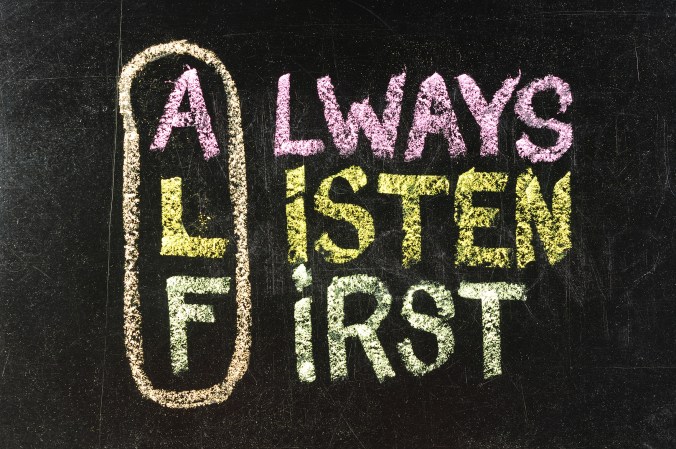 Listening, a task I struggle at. As a coach, trainer and speaker, I tend to be a problem solver. In fact, I think I’m so good, I’ll finish your sentence or thought for you. Why should you waste valuable oxygen. However, I’m finding the oxygen we breath gives a person the ability to take a breath and speak their thoughts, concerns and ideas. In fact, when I allow people to finish their sentence and thoughts, I find many provide valuable solutions or ideas. So as I continue to learn how to control my attention and listen more, I am finding that; from listening comes knowledge and from knowledge comes a true understanding. From understanding comes the wisdom to support or help. And from wisdom, comes the ability to solve problems. The common saying; “God gave you two ears and one mouth for a reason”, continues to be true throughout the ages. Learn to listen, and you will be more successful.
 LEADER INFLUENCE