Influential Leaders Never Use These Phrases

Believe me when I tell you that I can offend even when it is meant for praise. We’ve all said things that people interpreted much differently than we thought they would. These seemingly benign comments lead to the awful feeling that only comes when you’ve planted your foot firmly into your mouth.I recently read an article by Travis Bradbury, author of Emotional Intelligence 2.0. It offered insight into what to say in a conversation. I thought I would share some highlights with you. 


1. “You look tired” – Tired people are incredibly unappealing — they have droopy eyes and messy hair, they have trouble concentrating, and they’re as grouchy as they come. Telling someone he looks tired implies all of the above and then some. Instead say: “Is everything okay?”

2. “Wow, you’ve lost a ton of weight!” – Once again, a well-meaning comment—in this case a compliment—creates the impression that you’re being critical. Telling someone that she has lost a lot of weight suggests that she used to look fat or unattractive. Instead say: “You look fantastic.”

3. “You were too good for her anyway” – When someone severs ties with a relationship of any type, personal or professional, this comment implies he has bad taste and made a poor choice in the first place. Instead say: “Her loss!”

4. “You always . . .” or “You never . . .” – No one always or never does anything. People don’t see themselves as one-dimensional, so you shouldn’t attempt to define them as such. These phrases make people defensive and closed off to your message, which is a really bad thing because you likely use these phrases when you have something important to discuss. Instead say: Simply point out what the other person did that’s a problem for you. Stick to the facts. If the frequency of the behavior is an issue, you can always say, “It seems like you do this often.” or “You do this often enough for me to notice.”

5. “You look great for your age”– Using “for your” as a qualifier always comes across as condescending and rude. No one wants to be smart for an athlete or in good shape relative to other people who are also knocking on death’s door. People simply want to be smart and fit. Instead say: “You look great.”

6. “As I said before . . .” –  We all forget things from time to time. This phrase makes it sound as if you’re insulted at having to repeat yourself, which is hard on the recipient (someone who is genuinely interested in hearing your perspective). Instead say: When you say it again, see what you can do to convey the message in a clearer and more interesting manner. This way they’ll remember what you said.

7. “Good luck”– This is a subtle one. It certainly isn’t the end of the world if you wish someone good luck, but you can do better because this phrase implies that they need luck to succeed. Instead say: “I know you have what it takes.”

8. “It’s up to you” or “Whatever you want” – While you may be indifferent to the question, your opinion is important to the person asking (or else he wouldn’t have asked you in the first place). Instead say: “I don’t have a strong opinion either way, but a couple things to consider are . . .”

9. “Well at least I’ve never…” – This phrase is an aggressive way to shift attention away from your mistake by pointing out an old, likely irrelevant mistake the other person made (and one you should have forgiven her for by now). Instead say: “I’m sorry.”

In everyday conversation, it’s the little things that make all the difference. Try these suggestions out, and you’ll be amazed at the positive response you get.

All You Are Is Full Of Hot Air! Moving From Words To Actions

c700x420Last Saturday morning I stepped out on my apartment balcony and saw several hot air balloons passing overhead. In fact, one was lifting off from the field across from the complex. As if I were a little kid, I excitedly called my wife over to show her the activity. She reluctantly came, and I began telling her how I was going to buy a hot air balloon, and I would take her up on a beautiful evening flight with a bottle of cabernet, and we would gaze into each other’s eyes into the evening sunset.

She looked at me and said, “All you are is a bunch of hot air.”

Hey wait a minute, I was romantic. Maybe that is why I was “full of hot air.” I am not well known for my romantic side.

Has anyone ever told you, you were full of hot air? If so, you are not alone. I think this post will help you understand why our words should not be hot air but rather backed up by the foundation of our actions.

It came to me that day while watching hot air balloons drifting overhead, that our words have a great impact on those we speak too. In fact, I realized that our words indicate our intended actions, but the follow-through is more important than any word in our vocabulary.

My intention is not to be a know it all, however, I think I know it all. If you don’t know it, then how will you solve it? Another, a fault I have is answering before I thought it out or committing before I realize what I committed to.  Had anyone ever say that to you? I hear it often because I talk too much. Regardless of the situation, I have the answer, and you will listen to it. My intention is not to be a know it all, however, I know it all. If you don’t know it, then how will you solve it? Another, a fault I have is answering before I thought it out or committing before I realize what I committed to.

I hear “you’re full of hot air, or that’s a lot of empty hot air coming from your mouth,” often. Probably because I talk way too much and have to get in everyone’s business to resolve everyone’s problems. Another, a fault I have is answering before I thought it out or committing before I realize what I committed to.Had anyone ever say that to you? I hear it often because I talk too much. Regardless of the situation, I have the answer, and you will listen to it. My intention is not to be a know it all, however, I know it all. If you don’t know it, then how will you solve it? Another, a fault I have is answering before I thought it out or committing before I realize what I committed to.

I know what you’re thinking, stop rambling and tell us what you are going to tell us.  Ok, Ok, got it. Here you go:

  1. Our actions build trust – Without trust, there is no influence, and without influence, there is no leadership. Deliver on what you say, and you begin to create trust.
  2. Our actions show personal responsibility – When, what we speak, is backed up by what we do, people begin to recognize the responsibility we have for achieving the desired outcome.
  3. Our actions create our reputation – You are known by your behaviors and the work you do. Make sure the things you say are truthful and backup by your actions.
  4. Actions show commitment – When we act, we validate our words, thoughts, and ideas.  We move from the verbal to the physical. Actions move our verbal commitment to the tangible result.

Our words are essential. They lay the foundation of our beliefs and our desires. However, they are merely words, actions prove our intentions and reflect our beliefs and desires.

Choose your words carefully, they must be backed up with actions.

stuffyoushouldknow-podcasts-wp-content-uploads-sites-16-2015-08-hotairballoons600x350

6 Ways To Add Value To Your Team

Business team shwoing thumbs upI don’t think there is ever an instance where one person is the team, or where one person is responsible for the success or failure of the team. Whether at work or within the family, I believe it always involves a team effort.

As I continue my leadership journey, identifying areas of improvement within myself and when coaching leaders, I am convinced success is always a team effort. Sure, there is always someone who leads the way, but I believe they are supported by the team who is like-minded and supportive of their ideas and efforts.

Experiencing what it really means to add value to a group, I have identified 6 ways to increase the value as a team member.

Here they are:

  1.  SUPPORT THE VISION – Support the vision and direction of the team leader or team itself.  You must be honest with your thoughts and ideas, but in the end be a verbal proponent of the team and the direction the team wants to head.
  2. RESPECT OTHERS – You must comply with the ideas and or concerns of others. Never just dismiss what others have to say or the direction they believe in.  But rather, listen to what they have to say and consider the overall impact it has on the team goal.
  3. BE PREPARED TO GO ABOVE AND BEYOND – Teams need members that are willing to go above and beyond.   You might have to do more, take more and work more.  Be prepared to give it your all to the success of the team.  Be a better planner.  Be a better goal and objective setter and by all means be prepared to hold yourself accountable!
  4. BE THE EXPERT – Great team members are informed by team members.  The best performing team is the most knowledgeable team.  What is our objective?  What do we want to accomplish? What is my role?  Remember, information is knowledge.  The more knowledgeable the Team is, the more likely they are to be successful.
  5. CELEBRATE SUCCESS – Most do not do this well. How often have you achieved a goal and there was no fanfare? No celebration?  It almost seemed success was expected.  Maybe so, however, I believe celebrating your successes (regardless of how small) is the key to future encouragement.  Honestly, don’t be afraid to tell others how much you appreciate their effort and help to accomplish the team’s goals and objectives.
  6. BE A GO TO PERSON –  People appreciate those they can go and talk to.  Individuals who can simply listen and those who convey confidence and support and who are viewed as discrete and trustworthy?  A person that you can bounce off ideas and concerns and know they will simply be heard.

Consider these when working with a team. Only small visions can be achieved without a team. However, one can achieve endless visions with active teams!

Creative Business Team Stacking Hands In Huddle

What Message Are You Sending? 8 Principles for Sending Effective Text- Part 3 of 3

Here are seven (8) texting principles I found to be very helpful:Fotosearch_k26085789

  1. Be careful with abbreviations. Texting is meant to be a fast form of communication, so we tend to use abbreviations and shortcuts such as “np” (no problem) or “u” (you). But there is such a thing as an inappropriate abbreviation and acronym.
  2. Watch your tone. Texting is a fast and easy. Make sure you use words that set your intended, not perceived tone.
  3. Never send bad news via text. I had a CEO fire two VP’s via text. I was shocked. Guess he was scared of them. Keep texting positive or neutral.
  4. Don’t change meeting times or venues in a text.  However, you can confirm meeting times or places through text.
  5. Double check when using the voice-to-text feature.  The translation can be tricky.
  6. Don’t text during a meeting or presentation. This action is just rude!  Even if you are doing it under the table or behind a book, the presenter can tell.  As a speaker and trainer, it offends me when I see people looking at their phones.
  7. Darn, autocorrect!  This feature bites me often. Watch the auto correct feature.  An excellent way to fix this is to READ your text before you hit send.
  8. Don’t text and drive – This is a killer. 35% of all vehicle fatalities involve texting and driving. Even people who text and drive, hate people who text and drive.

textingBy following these simple rules and abiding by proper etiquette, mastering the ability to craft and send valid emails and text can be easy.   I crafted this blog, not only because of my shortcomings but also my frustrations.

How we respond to emails and text can result in positive or negative consequences and determine our influence on others. Spend the effort and time to make sure your texts and emails reflect your intended message.

What Message Are You Sending? PART 1 of 3 – 10 Rules and Etiquette for Crafting and Sending Effective Emails

email 2You’ve been there.  You get an email accusing you of some action or lack of action. The tone is rude and inappropriate.  The sender includes several people, many who have no reason to be involved. As you read what is written, the words spark enraged anger from deep within your soul.

You immediately react by hitting “Reply All.”  In fact, you want to vindicate yourself, so you “Bcc” your supervisor. Through your rage, you unleash a barrage of words that support your position.

Immediately, after hitting the send button, you receive a text from your boss.  Yes!  He wants to congratulate you on an excellent response!  Only when you open the text, it says “meet me in my office first thing in the morning.”

Emails and texting, perceived in the wrong way, can lessen or eliminate the influence email-logoyou have with your staff or groups. The relationships you spent months or maybe years to build and foster are now in jeopardy.

Email and texting should never be a substitute for face to face communication or phone conversation. However, if crafted properly, these can be useful in reinforcing your ideas and increasing your influence.

In part 1 of my 3 part series, I provide 10 rules and etiquette for crafting and sending using emails.

I find these very useful and productive to lessen the chance of responding in a destructive or unprofessional manner.

EMAIL

When preparing or an email consider the following 10 suggestions:

  1. First, consider a face-to-face or phone call before sending an email. 
  2. Send the email to those that absolutely need to know.  
  3.  “CC” people for information only.  “CC” responses should only be sent if the data reinforce or add additional pertinent information.
  4. Make sure the “subject” accurately depicts the content.
  5. Content must be specifically related to your “TO” group. Be precise, concise, and clear.
  6. Begin the email with a positive statement. Sets the tone for the responses.
  7. Continued disagreement or confusion, set up an in person meeting, conference call or video chat.
  8. READ IT BEFORE YOU HIT SEND AND THEN READ IT AGAIN. Read and re-read your email.  Make sure your grammar, spelling, and choice of words portray the intended tone and message.
  9. Emails should NEVER be used to reprimand, counsel or address disagreements. 
  10. When in doubt…….have a face-to-face conversation.

10 Actions To Increase Your Influence With Others

Want to be influential? Do these 10 things.

  1. ENCOURAGE – Start every conversation with something positive about the person or group you are addressing within the first 30 seconds. People are motivated by encouraging words.
  2. UNDERSTAND YOURSELF – When I think about what needs to happen or take place, I reflect on how my actions, my conversations, and my vision will affect others. I’ve realized that my performance is a direct reflection of my leadership.
  3. KNOW WHAT OTHERS GO THROUGH- Understand the trials and troubles others go through by being a part of their day. Good leaders become someone who listens to their people, not to reply, but to understand. Get in tune and know the people you lead and you will increase your influence.
  4. REALIZE EVERYONE IS DIFFERENT – They understand Good Leaders Ask Great Questions (read this book from John Maxwell). The right questions will uncover a person’s interests and what motivates them. I think it is important to connect by finding common ground and nurturing relationships.
  5. HELP OTHERS – I have learned when we are first to offer assistance and aid, we begin connecting in such a way that our relationship allows us to influence. Zig Ziglar said, “You can have everything in life you want if you will just help enough other people get what they want.”
  6. ADD VALUE – Add value by finding out what is important to those you lead. The value will look different in every situation. A good leader will ask great questions to identify what value looks like.
  7. SHARE STORIES AND EXAMPLES – As a speaker, I’ve learned the importance of sharing good relevant stories. As a leader and professional, I’ve recognized the importance and effectiveness of sharing good stories with those I influence. People want to see the human side of leaders. I believe stories create a sense of belonging and connect us through life’s similarities.
  8. NO STRINGS ATTACHED – Christopher Reeve said: “Success is finding satisfaction in giving a little more than you take.” When we give without any strings attached, we will benefit professionally and personally and professionally.
  9. REMEMBER NAMES -Learn the names of those you meet and associate with. Few sounds are as sweet to a person as hearing their spoken name, few sounds are as irritating when you refer to someone by the wrong name. Remembering names, shows you value them.
  10. ACKNOWLEDGE STRENGTHS – I think one of the best ways to gain influence is to recognize a person’s strengths. Areas of their personality or employment that seems to tie them well to the organization. In fact, they will want to “Exceed Expectations,” not just meet them.

InfluenceWe all have influence, big and small. We all have things we are gifted or talented. Things we leverage by adding value to others. Whether it is our attitude, problem-solving skills or simply just our ability to laugh, we should be sharing our knowledge, experience, and influence. Employees respond to influence. We should work hard to increase our influence by adding real value every day. Do this, and you will improve your leadership. You’ve heard it before, “Leadership is influence, nothing more, nothing less.” People respond to influence. We must work to increase our influence by adding value every day. Do this, and you will increase your leadership. You’ve heard it before, “Leadership is influence, nothing more, nothing less.”
We must work to increase our influence by adding value every day. Do this, and you will increase your leadership. To lead others, you must influence! Do these 10 actions regularly, and watch your influence grow!

A Person’s Attitude Influences Their Behavior

I’ll never forget the story my daughter recounted one day. She heard this from a speaker in school. Although the story most likely was not true, it nevertheless painted a picture of what “attitude” is and the impact it can have on a person.

“ A man finds himself accidentally locked in a refrigerated boxcar. Unable to get out, he uses a knife to etch words and phrases onto the wooden floor, such as….”It’s so cold, my body is getting numb” and “I don’t have much longer…” As the hours go by, the man slowly succumbs to death. The next day, the man’s body is discovered.  His written records indicate death due to hypothermia, but the physical evidence shows that the temperature never dropped below 50 degrees.  If it wasn’t hypothermia that caused his death, then what was it?

If it wasn’t hypothermia that caused his death, then what was it?

ATTITUDE….straightforward.

He was going to die, and there were no other options. This story shows how dominant attitude can be and how it can dramatically alter the outcome of any situation.

So what happens when a person’s attitude interferes and affects their behavior? Can a person’s attitude be changed? I think it can. Let me explain.

I have long taught that behaviors can be changed and modified through training, accountability, etc. However, the individual controls their attitude. It’s a choice. The person will bring their own thoughts, feelings, and way of thinking about them and it will manifest outwardly with time. Attitudes determine our behavior. In fact, Webster dictionary defines attitude as; “a feeling or a way of thinking that affects a person’s behavior.” So a leaders job is to consistently influence a person’s behavior. Be persistent and eventually, you will influence their attitude.

Attitude is more important than anything else, it is more important than money, any of your circumstances, or failures and successes. It is more important than your appearance, your talent, or your skill. It will determine your ability to succeed in anything you do.

Attitude: mentoring concept and sign series for business.

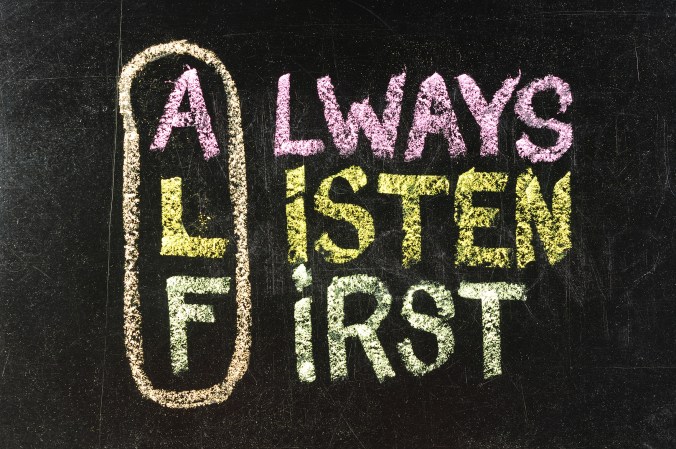
Listen First, Listen Second, Speak When You Understand

isten firstListening, a task I struggle at. As a coach, trainer and speaker, I tend to be a problem solver. In fact, I think I’m so good, I’ll finish your sentence or thought for you. Why should you waste valuable oxygen. However, I’m finding the oxygen we breath gives a person the ability to take a breath and speak their thoughts, concerns and ideas. In fact, when I allow people to finish their sentence and thoughts, I find many provide valuable solutions or ideas. So as I continue to learn how to control my attention and listen more, I am finding that; from listening comes knowledge and from knowledge comes a true understanding. From understanding comes the wisdom to support or help. And from wisdom, comes the ability to solve problems. The common saying; “God gave you two ears and one mouth for a reason”, continues to be true throughout the ages. Learn to listen, and you will be more successful.

Self-Leadership, My Most Difficult Challenge

businesswoman hands holding sign find your way text messageWhy is leading myself more difficult than leading others? I ask myself this question EVERY SINGLE day!

Why do I say or do things I know are wrong (there is a biblical reference here)? It happens at home, work, with my wife, with my co-workers and those I love and lead.

The answer is simple. There are areas I don’t see until they sprout up. In fact, I believe there are times I don’t see myself from a realistic point. I see myself from my intentions, AND others see me through my actions and words.  I should probably also admit that I see my intentions from the training and talks I give.

self-lead 2.jpg

While I speak of myself, I am sure I’m not alone.  But how does one address this issue? Answer, look for the blind spots and deal with them! However, how do we identify the blind spots?  I look personally to three source for my self-leadership:

  1. Scripture
  2. My wife
  3. Co-workers and staff

These sources provide direct and/or indirect insights to the areas I need to change or improve.  With this information, I can apply these five principles.

  1. Control Emotions –  Like anyone else, leaders have  emotions.  In fact, I believe a leader’s emotions can be more powerful due to the passion and desire for success they possess.  However, a good leader knows how to control their emotions and display or delay them based on the situation.
  2. Meditate – Leaders are achievers.  And that means they hit the ground running, which leaves little time to stop and think.  Spend 30-45 minutes every morning mediating on the things that matter and planning your day.
  3. Focus Your Effort Where it Matters– A good leader wants to achieve more.  They are never satisfied with their achievements. For me, I tend to want to fix everything and solve everyone’s problems. However, to be effective we must learn to focus our efforts on what really matters.  I heard John Maxwell say, ” You can’t be 100% all the time.” I find that statement very true.  We must identify the times and events where we need to be 100% .  Everything else gets a good effort,  just not our best.
  4. Serve Others – Zig Ziggler said, You can have everything in life, if you will just help enough other people get what they want.”  I am finding this to be very true.  Not from a selfish perspective, but simply from putting others first in every action or decision. Throughout my career, I have seen and reaped the benefits of putting others first by gaining their respect, commitment and dedication.  I simply look at it as, “you reap what you sow.”
  5. Get a Coach and/or Mentor – We all need to keep our minds sharp and our thoughts and ideas flowing freely.  Our minds can freeze or we experience those “blind spots” that throw us for a loop.  As a Coach and Mentor, I see the benefit from asking stimulating questions and the ability to seek wisdom and advice from others. I personally have at least five mentors that I can rely on for helping to address questions or walk me through situations.  I sleep better knowing I have access to these individuals.  I also can call several coaching colleagues for encouragement and guidance when needed.

Take the time to evaluate the effectiveness of your self-leadership to these five principles. Then establish a process where you consistently work to apply these principles and improve where needed.

A leader’s greatest challenge and most difficult task, is self-leadership. If you lead yourself correctly, you will influence others and they will follow.  Failure to manage your self-leadership will create a loss of respect and the inability to influence, causing people to leave and follow others.

self-lead 1.jpeg

Can’t We All Just Get Along? 6 Principles to Solving Conflict

Look conflict is noEmotional discussiont fun, it’s not pleasant and quiet frankly it  becomes frustrating and irritating.  However, conflict is inevitable and it’s actually crucial for success. Without conflict, one continues on a path of mediocre performance.  However, if  we address the conflict, the clash of ideas, positions and personal preferences can become fuel for change, innovative thinking and thought provoking new ideas. Unresolved conflict will destroy personal relationships and create a division within an organization or team.

John C. Maxwell said; “People naturally see themselves in the light of their intentions, but they measure others according to their actions.”  Man that was me.  I use to avoid conflict all cost. Well that’s probably not entirely true.  I think it would be more accurate to say, that I use to instigate conflict when I could.

Most leaders don’t respond well to conflict.  In fact, I believe most leaders will avoid it and choose the easiest, rather than the most effective way to handle it.  In John Maxwell’s Guide to Managing Conflict”, he listed six typical responses to conflict.  I found these to be right on, so I want to share them with you.  How many have you used?  Personally, I used all six at some time in my personal life or professional career.

  1. Win at all costs.  It’s like a shootout at the OK Corral. It’s quick, brutal, and destructive.
  2. Pretend it doesn’t exist.  Even if they hear no evil, see no evil, and speak no evil, evil will still exist. It will simply grow unsupervised.
  3. Whine about it. Playing the victim doesn’t cure conflict. It just irritates everybody on the team.
  4. Keep score. People who keep a record of wrongs can never start fresh. And nobody can ever truly get “even.”
  5. Pull rank. Using position never really solves conflict. It merely postpones it.
  6. White flag it. Quitting is a permanent solution to a temporary problem.

But, how can we address conflict and avoid these failed responses?  First, I think you have to truly care about the conflict, reason for the conflict and the person you have a conflict with. Second, we need to fully understand and comprehend the facts surrounding the reason for conflict.  Once we show we care, indicate we fully understand the facts surrounding the situation and we are prepared to approach a resolution from a humble perspective, then I believe you can effective solve the conflict.  How?  By fully implementing and following the 6 principles listed below.  Again, these were taken from John’s “Guide to Managing Conflict”;

  1. Confront a person only if you care about that person. It is more productive to go into a confrontation keeping the other person’s interests in mind.
  2. Meet together as soon as possible. When conflict arises, human nature is inclined to avoid it and procrastinate regarding resolution. The reality is, that by putting off confrontation, the situation can only deteriorate further.  Get together face-to-face.
  3. First seek understanding, not necessarily agreement. The person who gives an opinion before he or she understands is human, but the person who gives a judgment before he or she understands is a fool. The truth is, you cannot reach understanding if your focus is on yourself.
  4. Outline the issue. Be positive, describe your perceptions, state how this situation makes you feel, and explain why this is important to you. Engaging in this process without emotional heat or bitterness is essential.
  5. Encourage a response. Try to build a dialogue – be sure to let the other person talk while you actively listen. Maxwell talks about the following observations when confronting people:
    • 50% of the time people don’t realize there’s a problem.
    • 30% of the time they realize there’s a problem, but they don’t know how to solve it.
    • 20% of the time they recognize the problem and don’t want to fix it.
    • A solution can be had 80% of the time merely by engaging and seeking a response.
  6. Agree to an action plan. Be sure the plan clearly identifies the issue and spells out concrete steps that will be taken. The action plan should include a commitment by both parties to put the issue to rest once resolved.

Learn to identify the potential conflict and make adjustments in your approach, thinking Fight, two fists hitting each other over dramatic skyand desires.  However, if conflict occurs, then it must be addressed.  Following the 6 principles above will help ensure the conflict is fully, effectively and completely resolved.  Dealing with conflict won’t hurt relationships, in fact it strengthens the bond between people and teams.

John C. Maxwell said, “Successful confrontation usually changes both people, not just one.”  I agree.  Every conflict that I have effectively solved has made me a better leader.  I encourage you to resolve conflict quickly.  Don’t let it build!